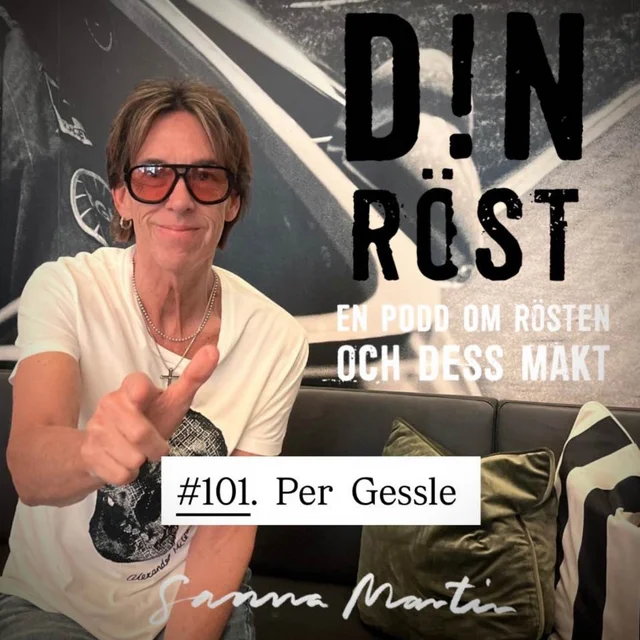
Din röst (Your Voice) is a podcast that puts voice, communication and engagement at the center. It’s hosted by Sanna Martin, singer, actress and podcaster, who played Meredith in the first Malmö production of Joyride – The Musical. Sanna sat down with Per and shared this podcast episode in July 2025. Listen to it HERE!
The voice has always interested Sanna on many different levels. The voice as an instrument, a means of communication, an opportunity and a responsibility, and a democratic tool. We all have a voice in one way or another. But how do we use it? That’s what she wants to talk about.
Sanna welcomes you to Din röst, a podcast about the voice and its power.
Sanna and Per meet at Hotel Tylösand in the Ronnie Peterson meeting room. Per says he thought they could do this in a really lovely little meeting room called Dolly, named after Dolly Parton. There are more meeting rooms: Ozzy, Dolly and there is this one called Ronnie Peterson. In the summer, Dolly is used as a shop. It’s between the reception and the pool. It’s much cozier. Sanna says this might be the biggest table she has ever sat at while podcasting.
Sanna starts the show by saying it’s such a great pleasure to welcome Per Gessle to her podcast. She explains that they are sitting in a wonderful conference room at Hotel Tylösand. It’s also so incredibly fun, because this was her first workplace ever in her life. Per is curious what she was doing. Sanna was a summer employee in 1993, 1994, 1995. Per says they bought the hotel in 1995. Sanna remembers it was a big talking point among the staff that Per had bought it. She didn’t work in the service department, but they heard afterwards that Per had had a dinner, people had served him, and everyone was so excited that it was Per Gessle. So for Sanna, it really is back to the roots to be sitting in Hotel Tylösand now.
Sanna recently picked up on something from Billboard. There are 18 songwriters in the world who have written three or more US number-one hits on their own. Of those 18, four were from Europe. There was Phil Collins, Paul McCartney, George Michael and Per Gessle. She quotes Per from an interview where he mentioned it really makes him pinch himself. Sanna wants to know how often Per goes around thinking about that. How often he thinks he has actually achieved something that’s completely crazy. Per says he doesn’t walk around thinking about it at all. But he is reminded of it all the time, like every day, by people who acknowledge him in different ways. Not least now that they are out on tour around the world. The hours you spend on stage remind you that something has happened, he says. Haha. But it’s not like he walks around thinking about it in that way. When he read the article, he was kind of like, what? It’s absolutely incredible: four from Europe. There is something very special about Billboard’s Hot 100 chart. America is America, and always has been and always will be. And as Europeans, to make it up there is fantastic.
Sanna says she was born in 1975, so she is 51 now. She was 15 when Roxette hit it big. She says everyone with some kind of Halmstad connection feels a certain amount of pride. About Per Gessle, and about both Gyllene Tider and Roxette, which have made such an enormous impact. There are a few artists from Europe, but there is one from Halmstad. She is curious about how Per found his way into music when he was growing up in Halmstad.
Per thinks it has a lot to do with the fact that he is a bit of a loner, filled with fantasies. He really loved pop music. He remembers The Kink Kontroversy album that came out in 1965. He was six years old then. When he thinks about his childhood, he thinks about standing there and miming along to We Gotta Get Out of This Place by The Animals, The Hollies songs, and The Beatles songs. He would mime along with one of those Couronne (billiard game) sticks. He would stand there miming and pretend he was Eric Burdon or Ray Davies. Or John Lennon.
Per had two older siblings: a brother who was seven years older and a sister who was 14 years older. Sanna asks PG if they were into music too. They weren’t. Bengt, his brother, had an excellent record collection that Per dug into. When he was at home and Bengt wasn’t, Per listened to his music. It was his taste in music that influenced Mr. G. It was very eclectic. Over the years, everything from John Lee Hooker blues to Joni Mitchell and The Beach Boys and Mahavishnu Orchestra. Everything has passed through Per.
When he started writing music as a teenager, he thinks the style of music was a kind of hodgepodge of everything he had listened to when he was little. But the most important thing for Per is still melodies. He has always tried to write beautiful melodies. There were so many beautiful melodies in the ’60s. For example, Burt Bacharach, McCartney, Brian Wilson, and Paul Simon. That’s something he misses a little in today’s pop music. Because people are now sitting and fiddling around on their computers all the time, those melodies have to come from somewhere else.
Anyway, Per spent a huge amount of time when he was little listening to music. And fantasizing. And pretending that he was in a band. He lived on Furet in Halmstad, by the folk park. He had some neighbours and he thought they should be a band. So they were supposed to stand there and mime too, and they thought it was terribly boring. But Per thought it was fantastic to have a band behind him. Haha.
But then Per did eventually form a band. Sanna wants to know how old he was when they started Gyllene Tider. That was a little later, Per says. His mother was very artistic. She and Per used to paint and draw a lot. But then Per became very interested in books and poetry, everything from Hjalmar Gullberg to all kinds of things. So when he was maybe 13 or 14, he started writing poems, or lyrics as they would later become. They are terrible, so he is not going to quote any. Haha. But it was nevertheless a way for him to start liking words. He started liking rhymes and meters. And that meant he simply started writing lyrics to music that he had in his head, because he couldn’t play any instrument. So he came up with melodies in his head for his lyrics. Then he adapted the lyrics to the melodies he was hearing. And that way he remembered those melodies. They had a piano at home, so little by little he learned how to play Für Elise. He gradually understood how music worked. Scales and keys and things like that. He learned by ear, he has never had any formal training. He thinks he was lucky in that way because around 1976, when he was 17, he started making his first home recordings on Spanish guitar and vocals. He sang his own songs. That was exactly when punk and the new wave era happened. That meant it was OK that it wasn’t all that good. Per liked that, because he definitely didn’t feel that he was particularly good. But he gained confidence from the fact that it was OK not to be that good.
If you go back a few years earlier, music was very elitist. It was very much, as he mentioned, Mahavishnu Orchestra. There were incredibly skilled musicians all the time. Billy Cobham and people like that. Whereas punk was the exact opposite. Anyone could be in a band and anyone could play. Per liked that. He was born in January, so he started school a year early. He was a smart kid, Sanna says. Haha. Per was only six when he started the school. He spent one year in the natural sciences program at high school, but it was a difficult time for him, so he dropped out of school and waited for the next year’s intake, which was the same year group as him. Then he started the social sciences program instead. There was a guy in that class who became a good friend of his. He played bass in a band. Per went with him to their rehearsal space and it changed his life completely. Sitting there listening to a pop band rehearsing, for real. It was the greatest experience of his life.
The drummer in that band was MP Persson, who became a very good friend. He wanted to stop playing drums and play guitar instead. So he and Per decided that they would form a duo. They called it Grape Rock. They started writing songs together. That was the first step toward Gyllene Tider.
Per started sending tapes and records to radio stations and record companies even back then. It was 1977. In 1978, he wrote Billy. He wrote När alla vännerna gått hem when he was 19. MP and Per thought they had something, but they needed more musicians in their little band. Micke Syd joined and played drums. Another guy named Janne played bass. They became the first lineup of Gyllene Tider. Long story, but what a beginning.
Sanna is thinking, as Per talks now, about the circumstances he had. Partly the fact that he actually had the freedom to just say, “I’m not happy here, I need to wait for my year group”. Sanna thinks young people are under such pressure today and it doesn’t work for everyone. But also the fact that Per had a rehearsal studio to go to. That’s also something people are talking about in society now, that it’s difficult to be young and find your way in music today. Because there are basically no rehearsal spaces. So much is being cut back in local municipalities. Sanna is curious what Per thinks about that. He agrees one hundred percent. It’s so different today. Our whole era is so different because everything is so computerized. That’s what makes people lonely for the wrong reasons. Per chose solitude because he wanted to sit with his headphones on. He would escape into a world of fantasy. It was self-imposed. There aren’t many kids who want to start a band today. All you need is a little laptop and you can autotune your vocals. You don’t have to learn things in the same way. That’s why things become very standardized. It’s a completely different time. Those who have seen how it was before, think it’s really strange. But people who are growing up in what exists now have never experienced anything else.
Sanna says with music and theatre and tours they are bringing people together. Even here at the hotel. They become meeting places. When someone is sitting at their laptop, they just miss that.
Per asks Sanna to think about what it was like in the ’60s and ’70s. What an enormous role culture played. Music, fashion, theatre, books, film. Everything influenced society in a different way. Everything was connected. Think about pop fashion in the ’60s. Mary Quant and Twiggy. The films of the ’60s and ’70s. Pop music and all those James Bond themes. Everything worked together. Great artists – Peter Blake did the Sgt. Pepper cover. The cultural world had a role in society that simply doesn’t exist today. Today everything is a Netflix series that looks like another Netflix series. Pop music is exactly the same. It’s very sad. What made you so captivated and enchanted by pop music was precisely the fantastic imagination of these crazy people. How Brian Wilson could write God Only Knows. That melody is unbelievable. There are so many examples. It was a collaboration. There was a damn cool album cover. There was an intense touring operation. All of these things somehow worked together. There were new things happening all the time. The Stones made Sticky Fingers. Andy Warhol did the cover. Then music videos came along a little later. There were also lots of creative people emerging and making really crazy videos. David Fincher, who later became a fantastic director, he made a lot of Duran Duran videos. Then everyone makes everyone else better in some way. When you are young, you need to be given the opportunity, and you need support all the time. That’s what is missing. Per doesn’t have any really young children anymore. His son is almost 30. He is a little past that stage. Haha. Per doesn’t really see any light at the end of that tunnel. Quite the opposite, actually. Now AI is coming too. What happens then?
Every day you bang your head against a wall trying to call somewhere. You can’t talk to people anymore. There is no one who talks. There is no one to complain to. No one to communicate with. When you are running through an airport, there are lots of people working there making sure the machines function instead of helping you with your luggage or check-in. It’s such a strange system. Of course we become lonelier. Of course we feel worse. And you check into a hotel, and there is this whole food-and-drink setup where you buy things automatically. Especially because there is no one standing there selling it behind the reception desk. Someone you can say hello to. That sounded pretty depressing, Sanna says. Haha. Per says it’s just because he has started getting old and he misses it. People are social creatures, after all.
Sanna says Per has been around all kinds of stages and sung for so many people, performed and written songs. There are so many profound values and connections that people have to what Per has written. Sanna and Per met when they did Joyride – The Musical at Malmö Opera, when the original production started two years ago, but Sanna has been listening to Gyllene Tider, Roxette, Per and Marie a lot. She remembers when they were sitting in front of the entire ensemble at Malmö Opera, talking a little about how the production came about and everything that Per created. She remembers that Per said Gyllene Tider called it quits and at the age of 26 Per thought he was finished as an artist.
Gyllene Tider made three albums. The last big album was Puls, which contained Sommartider and Flickan i en Cole Porter-sång. Those were the big songs. Then the other guys in the band were called up for military service, but Per wasn’t. He didn’t serve in the military, because he didn’t wear green, haha, but he made a solo album. It was his first solo album, at that point. It did well, it went gold, as they called it back then. Then Gyllene Tider came back and they made an English-language album called The Heartland Café. It didn’t work particularly well. Marie was one of the backing vocalists on that tour. She and another woman sang backing vocals. The English Gyllene Tider album was released in the US and Canada under the name Roxette, so the first Roxette release was actually Gyllene Tider. But nothing happened with that album. So after that, Gyllene Tider broke up. Anders Herrlin, their bassist, wanted to move to Stockholm and he thought they were boring. So Per made a second solo album. It was called Scener. That didn’t work at all. Marie sang on a few songs, but nothing happened with it. So Per wrote more songs in Swedish, but the record company turned them down.
PG was without a record deal at that point, in 1985. A lot of people got in touch with him to write lyrics for their music, because he had quite a distinctive style of writing lyrics. So he started writing songs and lyrics for different people. Among others, he got in touch with Torgny Söderberg, who asked him to write the lyrics to Kärleken är evig, which became Lena Philipsson’s debut. That was probably in early 1986.
Pernilla Wahlgren had broken through with Piccadilly Circus at Melodifestivalen and she had just changed record companies. The new record company CEO ran into Per at Café Opera and said, “We’ve signed Pernilla Wahlgren. Could you write her first single for us?” So Per went home and wrote a song called Svarta glas. Per sent it to the CEO, but he didn’t hear anything from him for several months. In the meantime, PG had played it for his old record company – the one that had rejected him. His record company boss said, “Write an English lyric for it, and then you can record it with Marie. You’d talked about doing something together. It’s a damn good song and it could be cool in English.” So Per changed Svarta glas into Neverending Love and that became the first Roxette single.
That turned into very long answers to Sanna’s questions, but she says that’s what Din röst is about. Per is the one who gets to talk. She says she has the single somewhere at home. PG says that LP is interesting, because the first Roxette LP is that rejected Swedish LP that he translated into English. So all those songs – Goodbye To You, Soul Deep, So Far Away, Like Lovers Do – all of those existed in Swedish originally. But they were the ones who turned them down.
The collaboration with Marie really started there. Of course, they already knew each other and Marie had sung backing vocals with Per, but Sanna is curious how it evolved.
Per says it was quite complicated, because he didn’t have a record deal. Whereas Marie’s career was very much on the rise. She had released her second album, Den sjunde vågen, and broke through in Sweden. So a lot of people at that record company – and it was the same record company Per had, or rather, the people who had rejected him – suddenly had Neverending Love sitting there. They didn’t think Marie should do Roxette, because it was a risk to her own career if it failed. Per’s stock at that record company wasn’t particularly high, to be honest. Whereas Marie’s stock was very high.
The single cover doesn’t have a picture of Marie and Per, because they didn’t want a picture of Marie on it, in case it flopped. So it’s a ’40s or ’50s picture of a cartoon couple on the cover. That was also a safety measure. But then things sounded different once the song became a hit.
They recorded the album, and it did incredibly well. And the biggest fan of all at that point was actually Marie herself, because she didn’t have to do this. She had her own career, with her own producer and her boyfriend at the time, Lasse Lindbom. It was never really that Roxette was created by Marie and Per and that they just moved forward like a locomotive. Roxette was something that happened.
And then, for every album, Marie went back to her own career, with her own team. Whereas Per didn’t really know whether there was going to be anything continuing with Marie. So after the first album, Marie went back and perhaps made Efter stormen. Per went home to his little room and wrote what became Look Sharp!. His strategy was pretty drastic. It was to make sure he wrote good enough songs that Marie would really want to record them.
So it wasn’t like with Gyllene Tider where the five guys worked their asses off together. Roxette was never really like that. But when it became really big, it became a machine, basically.
Sanna says she talked to Viktor Norén and Linus Wahlgren on the podcast a couple of weeks ago. They talked specifically about how Viktor comes from the rock world and has done quite a lot of musicals now, and thinks it’s really fun. He has really developed a taste for it. Sanna asked him: “What did your old rock buddies think about that?” He described it like some people thought one thing, some another. Some said, “I would never dare do this because of my image”. That anxiety is ridiculous, Sanna thinks. Surely you have to do what feels right for you. But apparently it existed even back then, even within the record industry. There were people who had opinions about what you were supposed to do. “Stick to what you know, sing in Swedish.” She is wondering what the hell they are worried about.
Per says people are worried. You can see what it’s like today. All pop music sounds – they talked about it before – very much the same. Because no one dares to stick their neck out and do something different. And above all, no one gets the support and money to be able to do it. Everyone takes the easy way out. When it came to Marie, this team had been working with her and obviously wanted to continue doing so. And then Per came along and disrupted things.
Sanna asks if Per made Marie even bigger. That’s what happened, but it was quite a difficult journey. As he said, his weapon was that he almost had to make sure it was successful in order to keep her with him. And when Look Sharp! came out in the autumn of 1988, they had released a summer single beforehand, which was Dressed For Success, and that became big in Sweden, but nowhere else. Then in the autumn they released Listen To Your Heart in Sweden, and went on their first really big tour – Himmelstalundshallen in Norrköping and places like that, 3,000-4,000 people – and then the album came out, and it was a gigantic success in Sweden. But it was still local.
Then it’s 1989, and it’s kickass in the US. Sanna asks Per to tell how that happened. Nobody really knows how it happened. Per remembers having lunch somewhere in Stockholm, and a guy from another record company came over and said, “Have you seen that you’re on the charts in the US?” Then Per looked at Billboard, and they had radio stations listed, and there was something called “Bubbling Under”. There were two songs that were on their way up at these stations and one of them was The Look by Roxette. And the fact that it was going to be The Look made Per completely drop his jaw, because the whole idea of Roxette, from his perspective, was that he wrote the songs and Marie sang them. And for it to be a song that Per sang… He actually sang The Look because Marie didn’t want to sing it. She kind of liked it, but it wasn’t her thing, she thought.
It had ended up in Minneapolis, at a radio station, via an American exchange student who had been in Sweden in 1988 and had become a huge Roxette fan. They had a radio program in Minneapolis at this station where listeners themselves could submit records and have them played on the radio, for various reasons. “I like this song”, or “my mom likes it and I really want to play it for her”. Haha. And he had gone up and left the Look Sharp! album at the station, but nobody played it. Then fate struck again when he went to pick up the record after a week or so. The station manager was standing at the reception desk and saw this guy picking up the record. The manager noticed the cover – it looks like the front page of a newspaper. So he asked, “What album is that?” “It’s a Swedish band. I left it here, but you never played it.” “Let’s go listen to it.” And the first song on the record was The Look. And the manager was like, “Damn, this is a great song. We’re playing it.” So they played it on the radio while he was there, and the phones started ringing. People were asking, “What is this?” There was an immediate response. So they kept it as a secret song on that radio station for two weeks. They talked about what it was, but it hadn’t been released in the US. Then that radio station belonged to a network with 17 or 18 other stations. So they also sent cassette copies to them. Suddenly there were 17 or 18 stations playing it across the US and they all got the same response. Everyone loved it. Our Swedish record company, EMI, in the US had also turned down the album. So suddenly they had no idea what was going to happen.
That’s such an incredible story, Sanna says. She asks Per if they invited that exchange student to lunch. The guy was there with Roxette on promotional trips in the US.
The Ronnie Peterson meeting room is next to Per’s car exhibition at Hotel Tylösand. Sanna asks Per about his interest in cars. PG has always loved cars. He likes design things. He doesn’t drive many of these cars that’s why they are standing here at the hotel. He can’t help loving them. He used to have them in so many different places and then he thought he would sell them off. But then Åsa came up with the idea when they built an extension to the hotel, “Let’s build a car showroom for your cars”. It’s really fun. There are so many people who come and admire these.
Sanna asks Per about visibility, that it is completely impossible to escape when he has worked the way he has. He became a bit of public property, both here and there. She is curious about how Per feels about it when he is walking around the hotel, or going into Halmstad, or Berlin, or wherever. PG says he has gotten used to it. He knows that once he leaves the house, he is public property in a way. It’s not something he particularly likes, but it’s also not something that bothers him. Some days he just can’t deal with it. He can’t be bothered to go to ICA, because he knows there will be four selfies and people wanting to talk about something.
Sanna thinks Per doesn’t go down to swim here at the hotel. PG says he has never swum in Tylösand in his entire life. Not even when he was little.
Sanna noticed that when Per walks into a room, for example, if they were to meet before the musical where they were working, people get a little on edge. There are more people than Per who have that effect on others, but if we take Per as an example now, Sanna thinks Per has always been very kind to them. From her side, they have always been able to talk. Sometimes people become a little starstruck around someone like Per, or rather, people get a little crazy. She is curious if Per notices it himself. PG often notices that people behave a little differently. He thinks it’s incredibly unnecessary. Sometimes he finds it amusing, but as he said before, he has lived with it since the early ’80s. He was around 20 or 21 when they broke through, so it’s not something he thinks about directly. But what is he supposed to do? Haha.
Sanna says as Per said, he had to constantly outdo himself to keep Marie interested. If we look back at 1985, 1986, Neverending Love, since then, quite a lot of water has flowed under the bridge. There was hit after hit after hit, and tour after tour after tour. Sanna doesn’t know the numbers, how many streams Roxette reached or how many huge tours there were. Per also has no idea. He knows that It Must Have Been Love passed one billion streams. Sanna thinks that those are such insane numbers. She is curious if Per ever thinks to himself, “Now I have to deliver” when he sits down to be creative. PG says he doesn’t think like that at all. It’s many years since he hasn’t thought that way since that particular situation leading up to Look Sharp!, because after that it took care of itself. Once you achieve success on that level, everything just keeps rolling along, in a way. He put very high demands on himself after Look Sharp!, when he wrote the Joyride album. Because it was supposed to form the basis for their first major world tour. Then they were lucky, because between Look Sharp! and Joyride, they got into the Pretty Woman movie with It Must Have Been Love. That was basically a free ticket.
Then the next phase he went through was Crash! Boom! Bang!, which he started writing in 1992-93. That was also very important. He was right in the middle of his life. A lot of good material was coming to him at that point, because he was probably at his best. He notices today, now that they are out touring with Lena and Roxette, when they play many of these old songs – Queen Of Rain and Crash! Boom! Bang! or It Must Have Been Love. He has no idea how he managed to write those songs. They are very cleverly written.
He remembers writing It Must Have Been Love on the piano, but he can’t remember why he made those modulations. Sanna asks Per if it is a myth that it was originally a Christmas song. PG confirms it was a Christmas song in 1987. It was written because they were trying to get the first Roxette album released in Europe, but nobody wanted it. Their German record company said, “We can’t get Roxette onto the radio in Germany. We suggest that you release a Christmas song, because maybe it will be easier to get it onto the radio around Christmas 1987.” So Per went home and wrote It Must Have Been Love (Christmas For The Broken Hearted). That was how it happened. It’s a very beautiful song, Sanna thinks. They recorded it and it became a Christmas hit in Sweden. People have forgotten about it, but in 1987 it actually went gold as a single. It actually came out around the same time as Tänd ett ljus by Triad, which has survived much better in Sweden. Haha. The Germans didn’t like it as a Christmas song either, so they didn’t want to release it. So it just sat there. Then after Look Sharp! they had hits in the US and they were invited to a lunch in Los Angeles. There was a guy there who asked Per if he could write something for a movie which at the time was called 3000. It was about a guy who hires a call girl for $3,000 for a weekend. It was later renamed Pretty Woman. Per said he didn’t have time to write anything, because they were on their way to New Zealand, of all places, to do promotion. But they had this really beautiful Christmas ballad, and he could change the lyrics. So the only thing he changed was “Christmas day” that became “winter’s day” in the lyrics. Then they did a new intro when they got back to Stockholm. After that, they sent it to a guy named Humberto Gatica, who was the biggest mixer in the US at the time. They knew him because they had had two American No. 1 hits. So he mixed It Must Have Been Love and used his “lucky snare” sound, as he called it. It gave the drums that particular sound. Then that movie became huge, as everyone knows. It Must Have Been Love became Roxette’s biggest song.
Sanna says Per is out on the road – or perhaps not so much on the road, but more hopping from continent to continent. He is touring with Lena and the first gig they did together was more than a year ago. It’s been received fantastically well and Sanna thinks it was an incredibly smart move to actually give people the chance to hear the songs live again. Lena does an incredible job. It’s an intense period and Sanna is wondering, how the hell Per can manage it. Mr. G says it’s fun. It’s also so rewarding to be able to travel to all corners of the world and play these songs and get that response. People come, everyone sings along, and everyone is happy. It’s wonderful.
Sanna wants to know if Per is at his happiest when he is out there meeting the audience live or he longs a little for those studio sessions. Per says they are completely different things. Working in the studio, writing, the actual songwriting process in itself, it’s always a struggle. He is not someone who sits down and writes for eight hours a day. He only writes when he has an idea. If he doesn’t have an idea to start from, he doesn’t know what to do. He needs an idea. If he has an idea, he knows there is something there. Then he keeps working on it, but it’s a struggle all the way through. How the song is going to turn out, which direction it should go in, what the arrangement should be, what the lyrics should be like, who should sing it. There are a thousand questions. But once you have a song finished, you go into the studio and work on it. And that’s a completely different process. You often handpick collaborators. Maybe another producer or engineer or musician, and so on. So then completely different things happen to the composition. He has said that it’s a love and hate relationship, because it’s really difficult. But when it turns out well, it’s the best thing there is. It’s the same in the studio. He never gives up, because he wants to be really satisfied with it. And when he is satisfied, he feels at his best.
Playing live in front of an audience is magical. Because there is such incredibly positive energy and power that arises from that collaboration with the audience. At the same time, some nights can be really difficult because the sound might be bad. Per loves playing pop and rock music together with other people. But sometimes it just doesn’t sound good for various reasons. It might be a bad venue or something has gone wrong. So there is really nothing that’s perfect.
If you took away any one of these three things – the songwriting, the producing, or the live performances – he would miss it. He wouldn’t just want to write songs for other artists. He finds it quite uncomfortable to write songs together with someone. You have to take so much into consideration and compromise so much. When he has worked with other people, it has often been that they didn’t work face to face.
It might also happen that he might take a piece from someone else. Mats (MP) has been involved in writing some Roxette songs, for example, Listen To Your Heart. Often, he has a little piece of music that Per takes, and then he finishes it in his own way. It’s not that they sit there and play together. When you are an artist yourself, you always want the best material for yourself. That’s just how it is. Many of Per’s favourites, Tom Petty, for example, and Brian Wilson, didn’t write that many songs for other people. Or Paul Simon. They wrote for themselves. Whereas other great songwriters, Bacharach or Max Martin, for example, are not artists themselves. They sit and write for other people all the time. But that wouldn’t really have suited Per.
Sanna is curious if Per has any special relationship with some of his songs. PG says he does. He felt it most clearly during the pandemic, when they did the acoustic tour. He reworked many of his songs as acoustic songs and then he usually chose songs where he felt the lyrics were strong. Födelsedag from Mazarin, for example. He did a slow acoustic version with just him and Clarence Öfwerman on a little piano of Ljudet av ett annat hjärta, which he wrote in 1980. It’s a very youthful love lyric, but it took on a completely different coloring when he performed it at 63, alone on an acoustic guitar at a different tempo. It acquired a different meaning. It’s special to do songs like that. Tycker om när du tar på mej. Those are strong, personal songs. It’s a lovely song, it’s beautifully constructed in all its simplicity.
Sanna asks Per if he had problems with his voice when he has used it at this level for so long. If it has always worked for Per. PG liked singing from an early age, but he has always had some kind of love and hate relationship with his voice. Because his voice is quite distinctive. When Gyllene Tider had broken through and Per made his first solo album, he lowered all the keys to get away from that classic Gyllene Tider high voice. In the beginning, when they were in the rehearsal studio with Gyllene Tider – when they started in 1979-80 –, the songs were in those keys, when you pushed your voice to the absolute limit. He could handle A major, so they played the song in A major. B major or B-flat major wouldn’t have worked. And G major gives you a little more room. So it wasn’t anything carefully thought out, it just ended up that way. If you think of Billy, for example, it’s in D minor, because Per wrote it in D minor. He didn’t know enough to think that maybe he should have written it in E minor or G minor. Everything just turned out the way it did. Then things got much better, technically speaking, with the voice, when in-ear systems came along. For Per, that was on the Room Service tour in 2001. It took him a very long time to get used to it, but since then, there has been no going back.
Sanna has never worked with them very much. She finds it difficult. Per says it’s difficult to get used to it, it takes time.
What’s good for Per is that in Roxette they often sing in octaves. And when he sings low – “Make-believing we’re together” – he is actually singing down there somewhere, so he sings very softly. His little sound engineer turns up the problems in his ears, so he can simply sing in tune.
When Sanna is thinking about how intensely Per and Marie toured back then, they have been all over the world, and it wasn’t only one gig per week, she is wondering if they ever had to cancel because they lost their voices. Per says they never cancelled. When they played in Zurich, they did three nights in an ice hockey arena. Marie got sick and lost her voice, but then she got some kind of injection, which the doctor said she was only supposed to have twice in her life. But she became completely… badabam, so she could sing. Per doesn’t even want to know what it was. Haha. But it was in the early ’90s.
Sanna’s impression of Per is that he is very open and easy to talk to, but he has also said no to quite a lot of things and been good at knowing his own boundaries, that he doesn’t want to appear on TV shows like Så mycket bättre or Stjärnorna på slottet. Per also mentioned that he doesn’t necessarily always want to be where there are the most people. Sanna wants to know how Per has learned what is sustainable for him and if it feels clear to him “No, I’m not going to do this”.
Per says he has always had quite a strong gut feeling about what is right for him. That doesn’t mean it’s right for you. Haha. He wouldn’t feel comfortable on Så mycket bättre or in those kinds of competition or game shows on TV. He highlights once again that his ambition or his dream isn’t to become a celebrity. That’s something that comes along with his success as a musician, in a way. Now that so much time has passed, he is more of a walking brand in a way, but it’s something that has happened, it’s not something he actively sought out. It’s mostly a sign of the times, in a way. He has never wanted to do those kinds of shows. It started early, back when they did Måndagsbörsen. They wanted Per to be in sketches, but he never wanted to be part of that sort of thing.
Sanna says another aspect of the voice is that there is an election this year. Sweden is voting in September, it’s only a couple of months away. Sanna is curious how much Per usually cares about that, what his view is on election and politics.
Per is pretty apolitical in that sense. He has never really said what he thinks, he doesn’t have particularly strong opinions. His father was a small-business owner, a plumber, and his mother was a teacher in porcelain painting and worked with her art. So Per has quite a lot of the same values they had, in a way. He doesn’t think about it that much. He has always voted. You have to use your democratic opportunity, he thinks. But people get so incredibly engaged in politics and he never did.
Sanna asks Per when he watches debates and things like that, if there is anything in Swedish politics that particularly annoys him. Per says there can be things that annoy him and sometimes he feels like he doesn’t recognize himself at all in the reasoning, but he doesn’t usually watch that many debates. In our time, you are constantly being overwhelmed by negativity. As soon as you open an app on your phone, there is Trump, and Lebanon, and Israel, and Putin, and all sorts of things. So you get tired of it in a way. Kind of like how you can get tired of music sometimes. When Per is working a lot, when he is writing, or when he has been in the studio or on tour, when he gets home he never listens to music. He wants silence. It feels a bit like that with the news too. It’s probably because in our time, social media is constantly overwhelming you with news. In the old days, you’d read your morning newspaper, and then you’d watch the news. Then that was enough. Sanna says we have a completely insane information society. We are being overwhelmed by all of this. Things lose their value in a way. Per also thinks it’s an age thing, because you have experienced what it was like before, you feel that now it’s whoever shouts the loudest who wins. It wasn’t like that before. It has become such a strange time. Sanna agrees with Per.
Sanna is curious if Per is looking forward to anything in particular in the near future. PG says it’s a tricky question. [The podcast was recorded well before the North American tour leg got cancelled by Live Nation. /PP] He is looking forward to going on the US tour in September, and Canada, because it’s been a very long time since they played there. It was in 2012. The US is a little special too, because they have always been huge on the radio there, and their songs have always been big, but they have never really cracked the live market in the US, because they haven’t spent that much time there.
There was something that happened with Roxette: once they became big in the US, they also became big in the rest of the world. The record company in the US wanted them to move to the US, but Marie didn’t want to, and neither did Per, but Marie absolutely didn’t want to. So they gradually focused mainly on Europe, and then made short stops in South America, Australia, and Asia, but not that much in the US, considering how big they were on the radio.
Marie passed away in 2019, but they already stopped touring in 2016. It was before the pandemic, when there wasn’t much live performing going on anyway. Sanna is curious how that loss affected Per’s desire to go out and perform. PG says he had just done a Gyllene Tider tour in the summer of 2019, and Marie passed away in December. Of course it affected him. At the same time, they were prepared for the fact that her death was near. She had been ill for a very, very long time. It didn’t exactly come as a surprise, but when you get news like that, it’s still some kind of “what?” It was difficult, and Per didn’t know what he was going to do with the music either, with Roxette and everything – what was right and what was wrong.
He needed all those years to think about what he was going to do. Eventually he felt a little like Sanna mentioned earlier: these songs are so big, and they mean so much to so many people. If Per doesn’t play them, nobody will.
He was working in a completely different context with Lena Philipsson, and when she started singing, Per heard the capacity she has. It takes a special capacity to be able to sing these songs. So that was also a matter of fate, the way it came about. He was sitting in a meeting with Lena up in Stockholm and asked her if she could imagine singing Roxette songs. She was obviously completely taken aback. But she went home and thought about it, and got back to Per. They met again, and then they played Fading Like A Flower, Spending My Time, and some of the others, acoustically, just the two of them. And it sounded fantastic. Per thought, Lena is incredibly much younger than him – she is only 60, but he also thought that she has worked in the music industry for 40 years, just like him – or he worked longer, actually. But she has worked for 40 years. The opportunity she can get through this, to travel around the world and play these songs, sing these songs, she can hardly expect to get that from her own catalogue. So there is a pretty nice upside for her too. That was Per’s clue, in a way. At the same time, he wouldn’t have been at all surprised if she had said no, because it’s a damn difficult role to step into Marie’s shoes.
Sanna thinks they did it in a very balanced way and Lena is fantastic. Per agrees, Lena is fantastic. She is good in every way, super-professional, and she has exactly the right attitude to things. She is attentive and she understands what she is supposed to do, basically.
Sanna says it feels like the audience is happy. PG adds that there were a lot of people on social media who slammed the idea. And there still are occasionally, but he hasn’t seen a single comment from anyone who has actually been to a concert and then criticized it afterwards. So the people who criticize it do so in theory, but in reality it’s not like that. Lena does a fantastic job.
Sanna wants to talk about the fact that Per’s songs are now also a musical. Or at least the Roxette part of his catalogue. Maybe there will be a Gyllene Tider musical too, who knows, Sanna says. She is curious what it was like hearing these songs in that context, with a particular story built around something else. Per says he was very skeptical about it. He has never really liked musicals, to be honest. He has seen Mamma Mia! and it’s just not for him, he thought. When the idea came up, one of the first things was that he wanted to be involved in shaping the music at all costs. Two of his closest collaborators, Christoffer Lundquist and Clarence Öfwerman, were given the task of helping arrange it, so it had the Roxette sound to it. And then Joakim Hallin came in, who is very talented, and did a lot of arrangements. The circumstances were kind of like that… a three-point safety belt around the whole thing. Once Per got into this completely different world and saw the work of the cast and heard them singing, he became incredibly proud, because he thought it was fantastically good. Now it’s moving forward; it’s opening in Germany next year, they are heading to England, the West End, and it’s going to Poland. So this will probably keep rolling along for a long time. Per will try to stay involved as much as he can, because he doesn’t want it to become bad. He wants it to be as good as it possibly can be. But there are new circumstances in every country. New cast, new set design, new venues. So it’s quite an adventure. He understands that Björn and Benny spent a lot of time on Mamma Mia!, and he understands why. There is a lot that can go wrong. But there is also a lot that can go right. Haha. Sanna thinks it’s great that Per is involved so much. PG says because he has shown interest, all the producers in different countries think it’s fantastic that he wants to be involved. If you can build a good relationship with it, it becomes a win-win. Sanna says Per should stay visible. PG says he sticks his nose into it.
Sanna says Per has a grown-up, adult son. She is curious what Per’s wish is for him to take with him into life from Per. It’s probably what he has already taken, i.e. that he is very independent, he thinks in his own way, he is driven and he is creative. He makes algorithms and things like that. There is a lot of AI stuff and he solves all kinds of problems. He has worked at all sorts of places, but he has started his own business now. Per says there is a tiny part of him that was very good at Maths when he was at school and his son got that. He is very good at Maths. That’s his thing, basically. He knows what opportunities there are and how to go about trying to create them. At the same time, he is a great guy. He is not a spoiled brat. He has never cared about those kinds of things at all. He is a good guy.
Sanna asks Per how he would most like to use his voice going forward. PG says he ended up back in the Roxette bubble after all these years – Lena and he started the tour in spring 2025 – and the last time he played Roxette material was 2016. So there was almost a nine-year break. Roxette is such a locomotive that once you get into it, it just keeps rolling. He could keep doing this forever. Per doesn’t know how long one wants to do it, but right now they are touring this year. [They were to have the last show in the US in October. /PP] Then they will see. Per is not thinking any further ahead than that. He is thinking about what Billy Joel did. He played every Monday at Madison Square Garden in New York for many, many years. The first Monday of every month. Something like that Per could also do at Hotel Tylösand. In the winter months, you do a few shows with some guests. Let’s see what happens. Sanna says that’s the best thing she has heard. Per says you can have a good meal and maybe 300 people in the audience. Sanna says then she would want to start working at the hotel again. Haha. She thinks it’s a fantastic idea. Per says it would be fun. Then he would be at home, no need to travel, deal with airports and all that.
Sanna asks PG if he lives in Halmstad or in Stockholm. Per lives in Stockholm during the winter, but he has a house in Halmstad and Halmstad is his home.
Sanna wants to know when Per feels at his very best. PG thinks it’s a difficult question. He probably feels at his very best after a show. He is quite affected by stress. The way he lives his life is quite stress-related. He sets demands for himself, he tries to perform. Not for commercial reasons, but he wants to maximize his capacity all the time. That means he always has a fairly high level of stress. When things are finished, it becomes very concrete after a big concert. You have played for 15,000 people and it’s simply been a fantastic concert. The sense of release that you experience throughout your entire system is absolutely magical, he says. But those are very selfish thoughts when he says that. Sanna doesn’t think so. It’s something you check off. Per was thinking more that when you feel at your best, Sanna might want to have some more universal plan for the planet. But Per doesn’t really have that. Haha. When he thinks back to his life, how he was as a child, he has always lived in a parallel world. He romanticized music a lot and how he wanted it to be. How he wanted to look, how he wanted to behave, what he wanted to do. And then, in some completely strange way, it became reality. He started writing, and it became successful.
He remembers when he got his first fan letter. He was completely shocked that someone he didn’t know had sent him a letter. A girl in Halmstad who had heard a song. There was a radio program at the time called Bandet går. Anyone could send things in and she had heard a song Per had sent in in 1976. She liked it and Per thought, shit, this can’t be real. This is exactly what you dreamed about when you were little – to get a response to something.
Sanna asks Per if he can still appreciate praise today or it just rolls off him like water off a duck’s back. Per says it’s incredibly nice to receive praise. Praise can be given in so many different ways. Just the fact that people come to a concert is, in a way, praise. That is perhaps the best side effect of what he does, that it has an impact, that you manage to affect other people. That people care. Because that is not really something you can manufacture. It’s simply an effect of something you have done. When you write a song, it’s never really finished until you yourself are moved by it in a way. It doesn’t have to mean you start crying. Maybe you feel that this chorus is fantastic. You yourself are the first member of the jury all the time. And then it moves on to someone else who feels the same way and that is magical. Sanna says it’s born again when it touches someone. And then it might be born again when someone else performs it. Per says it could happen that you might write something and then someone does a version of it that is completely different, and it might become even stronger. Because that interpretation might work better at that particular moment. That is how all the fantastic cover versions have worked. You can’t control that. That’s the power of music, which is absolutely fantastic. It’s such a shame that people aren’t encouraged more to enter this wonderful world.
Sanna asks Per what he would like to say to young people walking around with music dreams. Per says it’s not that easy, but you have to believe in yourself. Try to find a way to get it out there. So if you want to sing, or you want to write, or whatever it is, you have to try to find a way to do it. And it wasn’t easy in our day either. Because there has to be a certain threshold of quality somewhere. There were hundreds of bands in Halmstad, especially when they broke through in 1980. But there weren’t hundreds of good bands in Halmstad. When you read biographies of people who come from small towns, in the end, it was only them. The person who was good enough. But if you feel that you have something in your heart, you just have to hold on to it and keep going.
Per remembers when he started writing songs, nothing was good. The years went by and then suddenly, almost overnight, haha, after the first 10,000 hours, he wrote a good song. PG thinks it’s very much like that – you have to do it, do it, do it, and eventually, some kind of penny drops somewhere in your system. And suddenly, for no apparent reason, it becomes good. You can’t really say why. Yesterday it wasn’t good, but today it’s good. Today you managed to do it.
Sanna says it was a pleasure talking to Per and that it was wonderful having him as a guest on her podcast, a rather high-profile celebrity, haha. PG says it was nice to talk. They thank the listeners for joining them.