
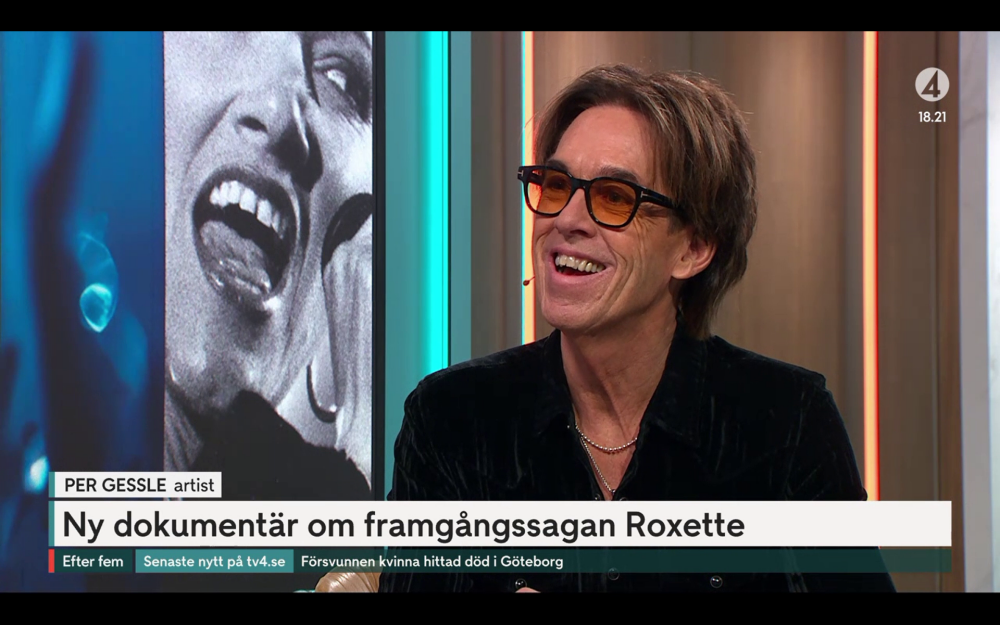
Per Gessle was a guest on today’s Efter fem show on TV4. Watch it HERE!
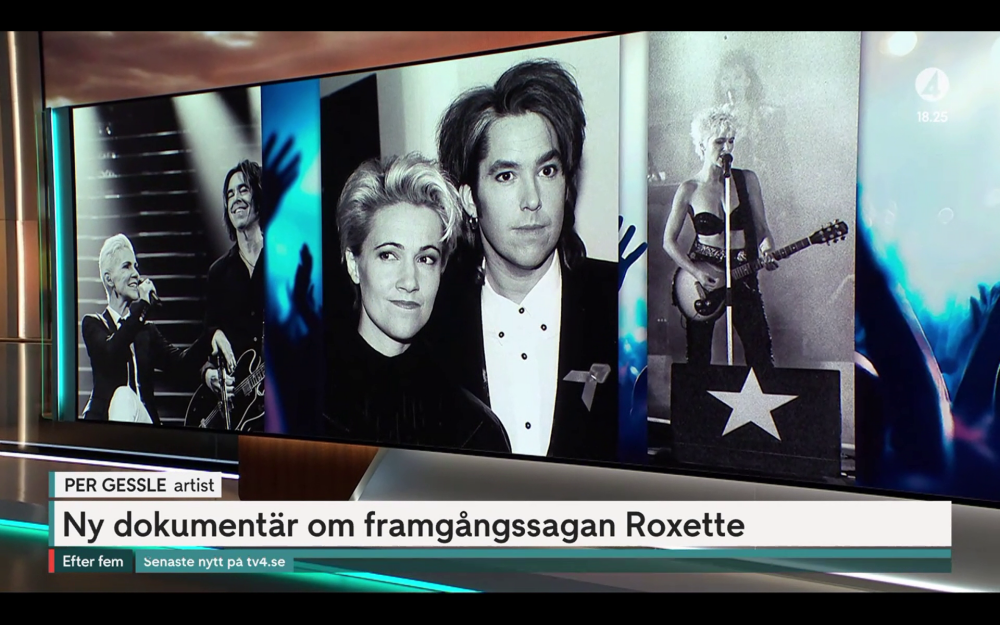
Presenter Anna Brolin welcomed Per to talk about the new documentary that premieres on SVT Play on Thursday, featuring private footage that has never been shown before. It follows Per and Marie, from their friendship in Halmstad to their major world tours. It takes us back to the time when Roxette conquered the world and everyone was talking about them. The mega-duo Roxette put Sweden on the world map.
Before Anna and Per start talking, host Henrik Alsterdal sums up the incredible career of Per and Marie. Forty years ago, in 1986, these two stars joined forces, combined their talents and Roxette was born. Their debut album, Pearls of Passion, featured their first single, Neverending Love – a major Swedish summer hit that made it onto the charts. Their first truly big international hit, The Look, was released in 1988. And the following year, they topped the Billboard chart in the United States. And the hit-making machine that was Roxette just kept going. This spring, their song It Must Have Been Love surpassed one billion streams on Spotify. Today, Roxette and ABBA are the only Swedish artists whose songs released before the 2000s have crossed that billion-stream milestone on the streaming giant. Roxette’s final tour with Marie Fredriksson ended ten years ago. Three years later, in 2019, Marie passed away at the age of 61 after a 17-year battle with the effects of a brain tumour. Now, the three-part documentary series Per and Marie – The Story of Roxette is being released on SVT Play. It is based on private films and photographs. Much of this material has rarely, if ever, been seen before.
Anna Brolin: Per Gessle, how does it feel to look back like this? To see all these old images?
Per Gessle: It’s fantastic. It’s an incredible journey we’ve been fortunate enough to experience. It’s absolutely unbelievable. Yes, it’s been 40 years this year. It’s magical.
Anna Brolin: I’ve actually had a sneak peek at the documentary, which premieres on Thursday. There’s a lot of private footage and material that has never been shown before. How did you feel yourself when you went through all of it and watched the footage?
Per Gessle: Well, you get a little tired of yourself.
Anna Brolin: Why is that?
Per Gessle: Because you’re constantly being bombarded with memories of things that happened. At the same time, it’s been exciting, because it reminds you of things. When you see them on screen, you suddenly think: Oh yes, that’s right! That’s right! There are so many things you’ve forgotten, but seeing them again brings them back.
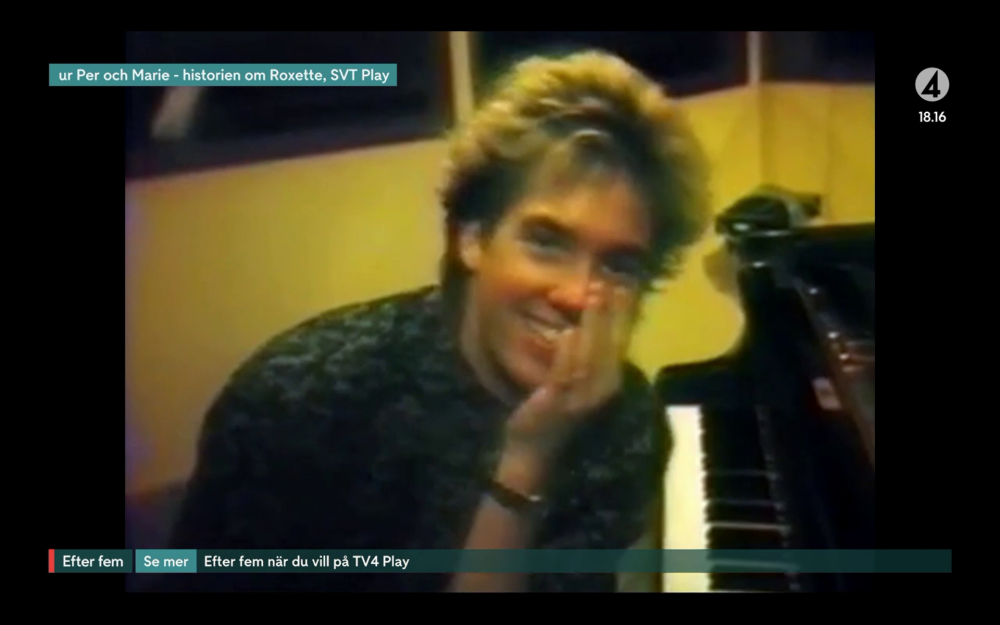
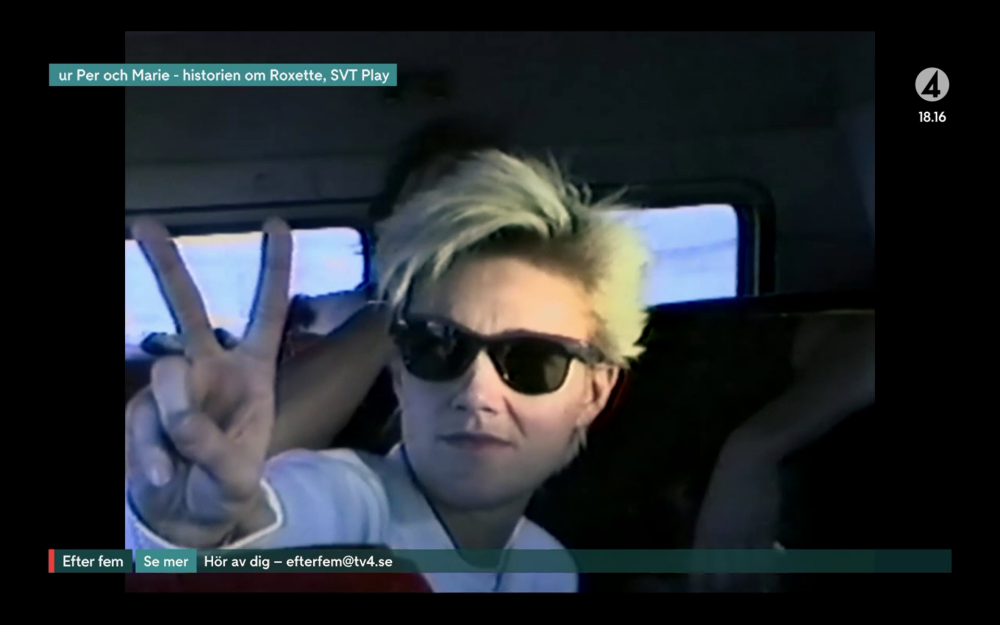
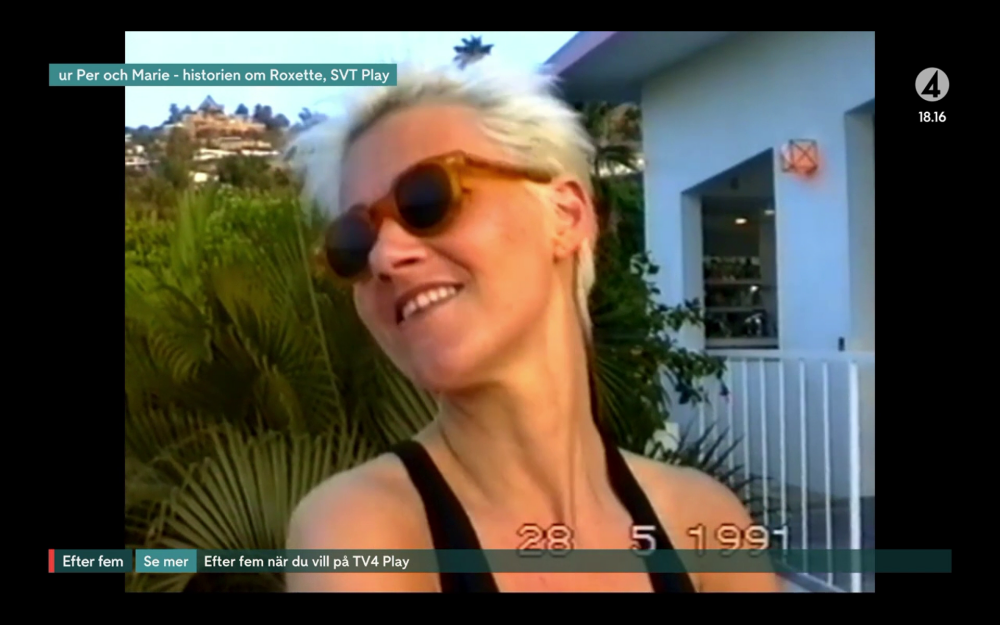
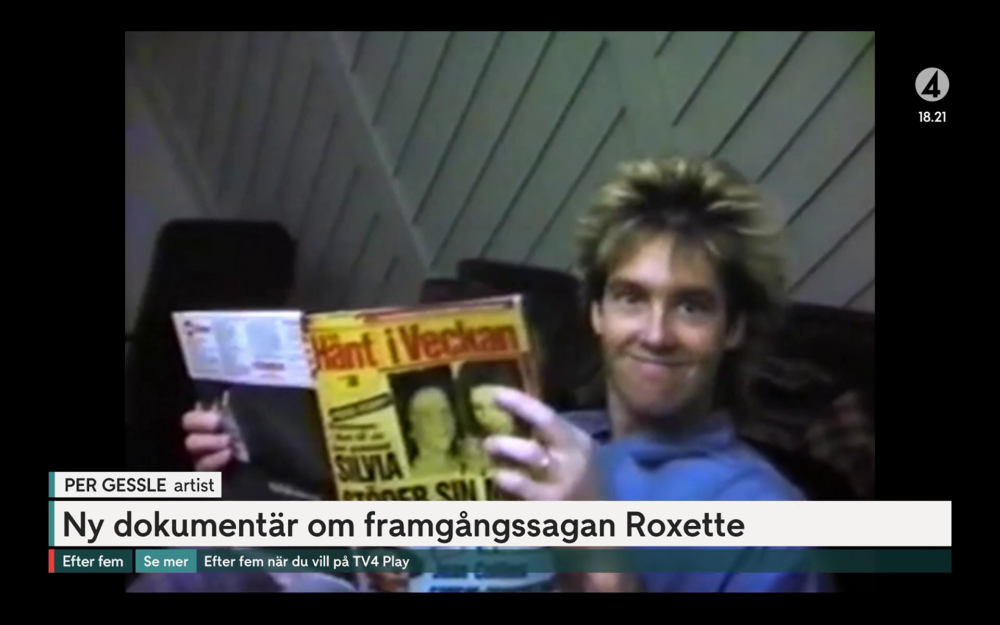
Anna Brolin: And we also get to see you with a camera. You’re actually filming yourselves when you go over to the US. Did you have some kind of feeling at the time that you were part of something historic?
Per Gessle: There was probably a sense of gratitude, or whatever you want to call it, that it was happening. You wanted to preserve it, because you almost wondered: Is this really happening? Is what we’re experiencing actually real? But I filmed a lot in the studio. For example, there’s footage of Marie singing Dressed for Success. She recorded that song in a single take. And it’s all on film. It’s absolutely fantastic that we have that footage.
Anna Brolin: What does that tell us about her, that she nailed it in just one take?
Per Gessle: Well, she could do it whenever she wanted to. Fantastic.
Anna Brolin: And it was a great song, too.
Per Gessle: Yes, she really did a fantastic job on it, I have to say.
Anna Brolin: And another thing we get to appreciate is just how big you actually were. When you reflect on what you achieved, what do you think? We were talking about Beijing and Buenos Aires. You performed in front of enormous crowds.
Per Gessle: Yes, we broke through internationally in 1989 and we didn’t take a break until the end of 1995. So those were many years. We were actually on the Billboard chart in the US for almost four years without falling off, I believe. We just kept changing songs. When you look back on it, it’s really quite unbelievable. But that was our reality at the time. It was fantastic.
Anna Brolin: It was a completely different era, of course, and a completely different music industry.
Per Gessle: Yes, absolutely.
Anna Brolin: What has changed the most?
Per Gessle: Well, everything, of course.
Anna Brolin: What struck me was how nostalgic it feels just watching those images. The concerts, no mobile phones, everyone completely present when you were performing.
Per Gessle: Yes, there was a certain power in the music and in the connection with the audience. Nowadays, everyone is on their phones. There are screens and elaborate productions. I think we had a little bit of pyrotechnics, and we threw balloons into the audience during Joyride. That was about it! It was simply a different time, but it was amazing.
Anna Brolin: I mean, your catalogue of songs is absolutely enormous. Today, the Swedish Grammy nominations were announced. We have Robyn, Zara Larsson, Yung Lean and Ludwig Göransson among the nominees. What you achieved back then was also a Swedish success story. What do you think Roxette helped pave the way for in terms of where Swedish music is today?
Per Gessle: That’s difficult to answer. But for us, it was ABBA. Europe had also achieved success with The Final Countdown, and so on. I don’t know whether people have been inspired by us, but the industry is completely different today. The world has become smaller in a different way, thanks to Spotify and streaming. Music is also made differently nowadays, with computers and all that. I think one of the secrets to our success was that we decided very early on to work with Swedish musicians and an entirely Swedish production team. In other words, we had a Swedish sound, which made us unique. Of course, we never imagined it would become as successful as it did.
Anna Brolin: But there must have been something to that approach, because it has certainly stood the test of time. There are still so many successful Swedish artists.
Per Gessle: Absolutely.
Anna Brolin: And speaking of streaming, It Must Have Been Love has crossed the billion-stream milestone. What is it about that song that makes it endure?
Per Gessle: Good God, of course, the film was a huge success. Pretty Woman was enormous at the time. And then the song became firmly embedded in people’s hearts all over the world. It’s absolutely incredible. It has also reached a billion views or streams on YouTube, so that’s just fantastic.
Anna Brolin: Your catalogue is gigantic, enormous and incredibly successful. Is there a particular Roxette song that you feel especially attached to, or one you’re particularly proud of?
Per Gessle: There are quite a few, but I still really like The Look.
Anna Brolin: And why wouldn’t you? It’s also a fantastic story: an exchange student took the record from Sweden to the US and managed to convince a local radio station to play it. And that’s how it all started.
Per Gessle: Yes, something like that.
Anna Brolin: What is it about the song that makes it one of your favourites even today?
Per Gessle: There’s something about the sound and the way the song is put together. When it’s finished, you just want to listen to it again. And that seems like a pretty good sign.
Anna Brolin: And in the documentary, through all this footage, we also get to see Marie and understand how the two of you dealt with the moment when everything really exploded. And you seem to have approached it in quite different ways. You get the impression that Marie was perhaps more vulnerable, while you just kept going like a machine, constantly creating new songs. How do you see the differences in the way you handled all of this?
Per Gessle: At the time, I didn’t really experience us as being particularly different. But I’ve come to understand afterwards that Marie had another side to her that she perhaps didn’t show very much. It’s not as though she was alone on tour. We were always together, you know. But apparently, she experienced a certain kind of loneliness amid all that success, in a way that I didn’t. That may also have been because I had already experienced some success earlier, with Gyllene Tider in the early 1980s, when I was 20 or 21. Whereas this international success was the first time Marie had experienced that kind of fame. Perhaps she didn’t quite know what she was getting herself into. I have no idea.
Anna Brolin: But we also get to see how she really gave everything when she was on stage and delivered those incredible performances. What was she like up there?
Per Gessle: Fantastic. We first met in the late 1970s, and back then she was a rather shy, humble pianist who sat down and sang. But she became an absolutely fantastic frontwoman on stage. Apart from being an incredible singer, she had the audience in the palm of her hand the entire time. Absolutely fantastic.
Anna Brolin: That particular quality she had – how valuable would you say it was?
Per Gessle: Well, she could just walk out there and own the stage. She was absolutely fantastic. And that’s something I realised quite early on. I could come up with a song, but I needed someone who could actually sing it, too. As soon as I started working closely with Marie, I began writing songs specifically for her. And Look Sharp! was the first album that was really written especially for Marie and her voice. So that was a jackpot.
Anna Brolin: A real jackpot, indeed. A big thank you, Per Gessle, for joining us. The documentary Per and Marie premieres on Thursday.
Per Gessle: Thank you.
Stills are from Efter fem.