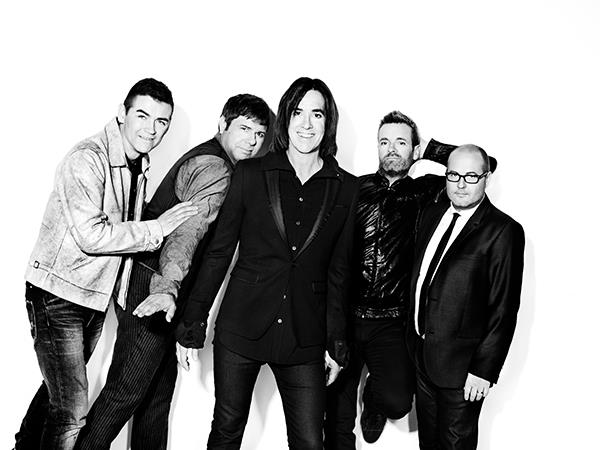
Since beginning of the year you, dear Roxette Blog readers, have been voting for your favourite Gessle, Gyllene Tider and Roxette songs. In the late autumn it turned out this would be the first time ever when Per mixes all his three music careers during one concert. Now we all obviously cannot wait untill the first Gessle solo tour in 8 years starts in the majestic city of Helsingborg. Only 19 days till the gig #1, just 10 if you’re attending the pre-premiere concert at Hotel Tylosand.
What we always did before the new tour starts was choosing the best, most-desired songs from the vast music catalogues. Remember the Silver blue-case where we were lucky enough to get a song so many people voted for performed live by Roxette? We absolutely loved that moment and we still feel humbled by your support and the impact we did together. We are hoping some of your suggestions might help Mr G to prepare a setlist of his (and ours) dreams – the band has started rehearsing, so “our prayers are in good hands tonight”.
There have been 10 polls since mid-January, 70 days of voting dedicated to 8 solo albums as we’re convinced they should play pivotal part in the setlist, whereas two latter votings were done around Gyllene Tider and Roxette live catalogues from 2000s. Nearly 1,000 unique users took part in this, so thanks much for your time and dedication, we really appreciate that!
When it comes to the concert setlist, no one should be expecting big suprises, should we? Gessle / Roxette / Gyllene Tider’s latest concerts were always more about pleasing big crowds (is it bad after all?), not fullfiling fans’ desires to hear forgotten pearls. There wasn’t many Gessle’s solo tours in the past, but just by analysing Mazarin 2003 and En händing man 2007 we can make initial assumption where 2017 takes us.
It’s less than a month till the EVK tour premiere in Helsinborg (6th of July, baby!). You have already voted for your favourite songs off Per Gessle’s 8 solo albums, but would it be a real Swedish tour of Gessle if there wasn’t any Gyllene Tider song there? You well know the answer. Obviously, voting for each album doesn’t make much sense as of now, so we came up with idea of mixing 2004 and 2013 Gyllene Tider concert playlists to see what songs you love the most.
As there are so many Gyllene Tider songs to choose from – this time you can vote for up to 5 songs. Let us know your choices!
The last poll covering Roxette vast catalogue pops up tomorrow!
In yesterday’s issue of Aftonbladet Söndag magazine there is a Per Gessle interview on 6 pages, including some killer shots of Mr. G. The interview is done by Monika Israelsson, the photos are taken by Maria Östlin.
Nashville, autumn 2016
This time Per Gessle ended up in Nashville, Tennessee, in T-shirt weather in October. Per tells Monika that if he needed a harmonica in an odd key, he would have just walked five minutes to find one in Nashville. Mr. G brought his closest gang with him and a bunch of demos. Per says he thought they should record acoustic sketches only and then bring in local musicians and see what they bring. He asked the owner of the studio if they could take a pedal steel guy and Dan Dugmore got there, an old hero. He was so good. The result is two albums, first out ”En vacker natt”. Strings and steel guitar provide a classic country sound, yet the white sand dunes and an empty beach appear (referring to Halmstad). On the album cover there is a girl in a headscarf, singing at the sea in winter.
Stockholm, April 2017
The photos were taken in Ölandsgatan in Södermalm, Stockholm. At one moment, when a car was getting closer, the stylist shouted at Per and the photographer to beware, but they weren’t stressed. It turned out the car didn’t want to hit them, just stop by and ask Per how Marie is. Per walks to the car, leans down and says she’s just fine. They chat a bit, then the car is leaving. Per looks happy and is joking there was no selfie asked. Though it happened yesterday. And the day before yesterday. Since Per was at Skavlan a few weeks ago and said that he “gets depressed if no one wants to take a selfie”, there are even more requests.
They walk back to the record company’s office and there Per says his existence basically depends on what people think about the things he does. The new albums are not mainstream radio compatible. Per says to Monika that when you are used to meeting the public, you will be disappointed if you don’t get the cheering. At a concert he then thinks: “Why don’t people scream like they do usually?”. But if they scream extra much, you feel “calm down, you all”. Haha. He says one is analyzing things to death.
Per keeps his private life safe and people don’t know much about him. This is how he wants it. He says he won’t ever be on Parneviks (Swedish show that features golfer Jesper Parnevik and his family as they welcome celebrity guests to stay at their mansion in Florida for a few days) or on Så mycket bättre (Swedish reality TV show in which each artist attempts to do their own version of another artist’s well-known songs, with each person getting an episode featuring all of their songs being performed by the other musicians). He doesn’t know what he could win with it. He is very pleased that ”Tycker om när du tar på mig” means something for people, but he or his life doesn’t need to mean anything to anyone. He doesn’t feel the need to show his home or his cars or where he buys bananas. Åsa and Gabriel are the same when it comes to such things.
Regarding himself being a small town guy, Per tells Monika that there is a difference in growing up in a big city and a small town, and there was even greater difference in the ‘60s and ‘70s. That small town mentality has colored him so much that it lies in his personality. He grew up in Furet district of Halmstad with his mother who was a teacher in porcelain painting and his father who was a plumber. He was a trailing child and a loner. He was more into lonely stuff, like painting and drawing. He always felt more like an outsider. His brother introduced him to rock music: The Beatles, The Kinks, Joni Mitchell, Leonard Cohen, who became a direct channel to another world, much more exciting than Furet.
Per tells Aftonbladet Söndag that he went to a tough high school. There were a lot of drugs, a gang that broke the seats in the bus. Being good at school was the worst thing one could do. His dad drove him to school because he didn’t want to take the bus.
He started to play in a band with Mats MP Persson. Per asks Gabriel if he knows what one misses when he doesn’t play in a band. There you have your friends and you can play together the same song and that sounds damn good. That thing is sensational. It brought him a kind of gratitude. He and MP started as a punk band that sounded terrible and developed into Gyllene Tider. Per was purposeful and he covered Halmstad with leaflets and sent cassette tapes to record companies. They succeeded when EMI offered a contract and they recorded their first album in 1979.
The early Swedish texts are like a highway into a teenager’s head and body. Over the years, the songs have become more thoughtful, but still they take off in everyday happenings, often including sadness. A fishing trip, a rainy morning on the beach, an old love on the bus. Per says he usually tries to keep a fairly high minimum level of texts. Sometimes a song is so contagious that the text doesn’t play an equal role in the context. But when the music is more naked and crisp, the lyrics become important.
Monika asks Per if he can really put himself in the lives of ordinary people, with his luxury cars and private jet. Per says he doesn’t write about townhouse life or a night on the subway. He thinks that just because you tell a story, it doesn’t mean it’s true. If that means something to someone, he has succeeded. Then whether he has experienced it or not, it’s quite uninteresting.
To the question why he doesn’t write sorely or about politics Per replies he doesn’t think he has had any political substance to come up with. Besides that, he doesn’t think it would be interesting enough. He is more towards the dreamy stuff. He thinks all people are political in some way when in a society. Mr. G thinks it’s unacceptable not to vote, it’s a democratic right so it’s better to vote for anything in that case. But he doesn’t really know how to use it.
Monika asks Per about his musical self-esteem. Per sayst it started at minus 100, he thought he sang damn badly. He started singing in Gyllene Tider because no one else would. Now he has learned that this damn voice is an asset. Everything that stands out is good.
Per thinks of himself as a kind of director. He always choose to work with people who are much better than himself. That can help him to pursue any kind of vision he has. He knows something will be fine, but he doesn’t know how to get there. He has always thought Marie Fredriksson is the best in the studio when Per is there. Mr. G means he thinks he makes Marie take one more step.
Per met his wife, Åsa in the mid ‘80s. The early years were significant in their relationship. Gyllene Tider’s English album and Per’s second solo album flopped. When looking at Roxette and his actual life, it’s easy to think that it has always been so. But it has not. He was a ”has-been” when he was 24 and it was damn hard for him. He lived on Åsa’s salary from Vingresor and had no real master plan. When Roxette had its break-through, it was evident that Åsa, with her professional background took care of the gang’s trips. This way Per and Åsa didn’t spend much time apart, despite long tours around the world. She often documented with a cam. The films became raw material for the Jonas Åkerlund documentary, Roxette Diaries (2015).
Per’s voice is shining when he talks about the ‘90s, the years when Roxette had several songs on the Billboard charts in the US for 4 years in a row. Per remembers playing Joyride for 200 radio directors in the US. It wasn’t even released, but they came to them to congratulate on their next “number one”. If you’re lucky, you have this success once in your life. Back then Roxette was exactly what America wanted. Nevertheless, they were never completely in the heat. The US record company wanted them to move to the United States and they would replace musicians in the band. But Per and Marie said no. Per says it’s one of the things he is most proud of, that they kept their gang. They created the Roxette sound together.
When Per is listening to old songs today he can be knocked out. Marie’s voice is amazing, Per says he can feel “damn how good she sings”. He smiles and says back then he didn’t sense it, it was more like “sing better!”.
Monika and Per talk about the times when Marie got ill and that Mr. G among others thought it was the end of Roxette. He started to work with Gyllene Tider and did solo projects. Then in 2009 Marie and Micke came to Amsterdam and Per asked Marie to come up on stage to sing Listen To Your Heart. He thought people would die for it. Marie didn’t want to, but Per knew she wanted, so it took like 15 minutes to convince her and she said OK, let’s try it.
Per is grateful for the Roxette tours and albums during the past years, saying he felt something of a “brotherhood responsibility”. Today they talk regularly.
There is a deep melancholy in the music on Per’s new album. In recent years, Per has first lost his mother and then his brother and sister, who both passed away in cancer. Mr. G says when people die around you, you grow older sooner. There is a thoughtfulness and one is thinking more about everything. He says he has to stop himself so that he doesn’t only write about what has been, but about what is and the future too. When his sister died, her son found a box of old diapositives from 1966. It is Gunilla who stands by the ice and sings. Per has selected some of the pictures for the albums. It felt like they fit the record.
Per’s replies to special questions:
5x the last time I…
… cooked: ”Scrambled eggs. I’m miserable in the kitchen.”
… bought something extremely expensive: ”A dulcimer, a string instrument. Pretty expensive but very fine.”
… loughed out loud: ”Quite a lot of times last week, when I was watching Dag, the TV series.”
… felt ashamed: ”I’ve stopped doing that. No, in fact, I feel ashamed just now about this answer of mine.”
… took a selfie with someone: ” Yesterday in a car shop. Then you just have to be in for it!”
3x the coolest cars in the world:
Ferrari Dino: ”Cars don’t have to be practical. And they don’t have to drive at 350 km/h, because you never drive that fast anyway. However, it’s important that they are beautiful.”
Mini Cooper: ”Classic, the one Austin Powers drives.”
Rolls-Royce Corniche: ”So incredibly beautiful car. This is the one of these 3 I don’t own.”
3x people about Per:
Marie Dimberg, manager: ”Per, like most other artists, is hard-working, creative, target-oriented and focused. What distinguishes him is his amazing songwriting that gave him three careers: Gyllene Tider, solo and Roxette. I don’t think there is a big difference between the private and public Per. He is immensely positive and thinks fast both inside and outside the job. And he is just as bad at keeping the time in both cases…”
Marie Fredriksson, artist: ”Per is extremely creative, focused, positive and cheering in the studio. This is how he is as a person. We’ve had so much fun together through all the years. We had a lovely dinner together just the other day. There were many memories that came up and it’s obviously nice with such a long friendship that it continues even outside the stage and the studio.”
Mats MP Persson, band member in Gyllene Tider: ”My first impression of Per was that he was a real artist, translating Leonard Cohen’s and David Bowie’s lyrics into Swedish, and he had a tape recorder with microphones that could be used to play and record. He also had great visions. I thought it was really exciting and once we started doing covers with Per’s translated lyrics, for example, Doctor Feelgood. We did everything on our own and called us Graperock, if I remember right…”
3x this is how I wrote the song:
(Dansar inte lika bra som) Sjömän (Gyllene Tider, 1980): ”One summer I was weighing mushrooms. There were over three hundred girls and two guys. When we had nothing to weigh, we sat in our Ford Transit, where I wrote the text and then we made a song of it in the evening. Just because I could. In a way it was like solving crosswords.”
Allt gick så fort (En vacker natt, 2017): ”This song wrote itself. I was in France on a beach, a woman was picked from the water. I don’t know what happened to her afterwards. It became a catalyst for the fact that life goes fast.”
Neverending Love (Pearls of passion, 1986): ”I wrote a song for Pernilla Wahlgren, Svarta glas. Then I accidentally heard that her brother Niclas had recorded it and that was not the idea. I made an English text instead and recorded it with Marie.”
There are captions next to the photos in the article including Per’s thoughts on Roxette was the second pop group ever to play in Beijing. The concert in 1995 was met by both criticism and praise. When they played It Must Have Been Love, there was a banner in the audience saying ‘one world one unity’. One felt they became their longing for a Western life. The whole band went out and cried afterwards.
Another caption says that despite his worldwide success, Per Gessle remains a small town guy. He has never left Halmstad. By many, he is still perceived to be private – and that’s exactly how he wants it.
In a third caption it’s written that Gyllene Tider’s first hit wasn’t obvious. Per says they were told that the first single must have a certain pace to make it disco comaptible. But just then Frank Zappa happened to have a hit with Bobby Brown and that was very slow. So some discos in Stockholm started playing Flickorna på TV2, which had the same pace. Slowly but surely people began to recognize it. An organic hit, that’s the best kind.
The article closes with Monika’s thoughts that among the memories flowing from Per, names, places, anecdotes, she can’t find the right moment to ask why Per makes new records and gets out on exhausting tours when he has millions on his bank account. But eventually it becomes irrelevant. It is clear that Per Gessle lives and breathes music.
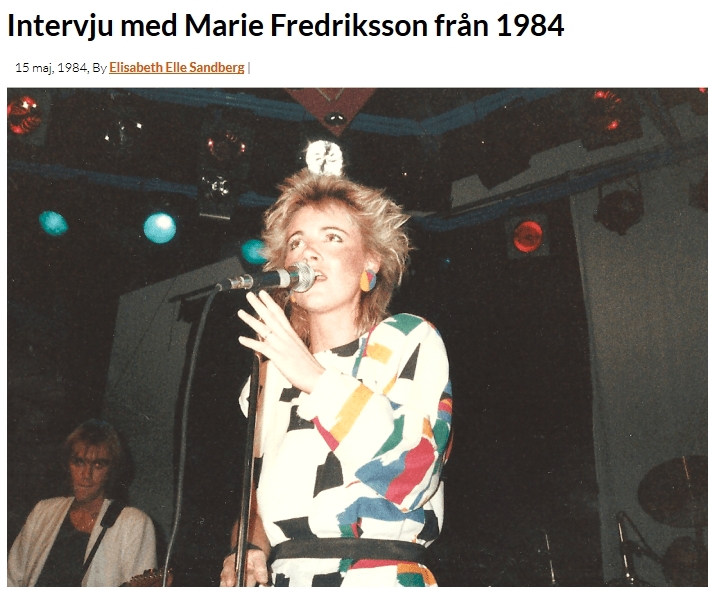
Another fab interview popped up in Elisabeth Elle Sandberg’s archives. Some weeks ago she shared an interview she did with Per Gessle in 1985 and now it’s Marie’s turn. Elisabeth did an interview with her in 1984, probably on 15th May, just some days before Marie’s 26th birthday. How awesome it is! Thanks a lot again, Elisabeth for sharing such gems with the world!
The interview starts with the intro telling that Marie Fredriksson has recently released her single ”Ännu doftar kärlek”. It is a ballad that Marie has written together with Lasse Lindbom. On the back side there is a song written by Per Gessle, ”Tag detta hjärta”. What happens in the future will depend very much on how the single is received. The upcoming LP is released when it feels timely, possibly in August.
Marie tells Elisabeth that it was planned that the LP would be released this spring. They wanted to wait a bit, so they had time to write some more material. She says she will go to the studio again in June and record 3-4 songs that they have written now. Possibly they release another single in summer and it depends on how it goes with it. She will probably record a video and it will be very exciting.
Marie also talks about the fact that most of the material on the LP she wrote together with Lasse, but there are also some songs that she herself has written both music and lyrics to. Martin Sternhufvud also made a song that will be included on the LP which is damn good and Marie is very proud of. Per wrote a song that is the B-side of the single. Marie also worked together with Björn Holmgren, who is a director in Halmstad. He is very good at writing and has written some children’s plays. On the LP there is a song he wrote the text to and Marie wrote the music.
Miss Fredriksson tells Elisabeth that she is happy that Lasse and she have been able to write so well together. They didn’t know it, just tested it for fun and it worked damn well. Everything is exactly as Marie imagined, but she says they have to see if it sells. You’ve done what you could, you’re only human. But if people don’t want to buy it, you have to do something new. Marie thinks the mmost important is that she is satisfied and she 100% is.
Elisabeth asks Marie if she can make a living on music. Marie says it’s OK. She was on tour with Gyllene Tider and she got paid. She managed to have her apartment in Halmstad. Later in the summer she will tour with Lasse Lindbom Band. She will be there as a guest, just as she was on the Gyllene Tider tour. In autumn, when her LP is released, she will go on tour and will go with Lasse and they will have the same band. Marie says they should not work as Dan Hylander and Py Bäckman, but Lasse does his songs and Marie hers. There will be two performances, so the audience get double value for their money. Then they do the end together. After that she decided to go on a bigger tour. It will be her first thing, which she is in charge of. The musicians will be Pelle Andersson and Pelle Sirén from the X-models. They are not known, but very talented. Probably Janne Bark as well, but it is not decided yet. Even Backa Hans (Eriksson, Elisabeth’s comment) who have played with Lundell and perhaps Göran Fritzson from Gyllene Tider. It’s a great mix that feels very fresh, and there are some new people.
Elisabeth asks about the band Marie played with last summer. Marie says unfortunately she doesn’t play with them now, but it was fun and they are thinking about doing some gigs together this summer, maybe in August. They have some contacts in Kungsbacka and Falkenberg, who would like them to come back. But with them she does only covers, no own songs.
Elisabeth is curious about how it feels to be on tour with Gyllene Tider. Marie says she had a blast and it was really fantastic. It was very fruitful for her. This spring she learned a lot about stage experience and how to talk to the crowd. She performed one song as a guest. They were on tour for 5 weeks and they became like family, so it was sad when the tour ended. And it’s not only the band, because Gyllene Tider you meet every now and then as they also live in Halmstad, but also the crew who take care of everything from sound to lights, they won’t see each other for a long time.
Marie is asked what she thinks about Swedish female rock singers? For example, Py Bäckman and Anne-Lie Rydé. According to Ms Fredriksson, Anne-Lie Rydé is really good. Py Bäckman is a wonderful text and music writer. Her latest LP is very good. She has also written a text for Marie and she is now making music to it. Marie says she saw Anne-Lie Rydé when she was in town last time. She is very good on stage. But Marie likes Py Bäckman’s depth. Elisabeth asks about Efva Attling and Eva Dahlgren and Marie replies that she liked Eva Dahlgren’s latest LP ”För väntan”. Marie thinks Efva Attling is very professional on stage. Marie says if she goes to a concert or is listening to an album, then she wants to feel something.
Talking about Swedish male singers Marie says Mikael Rickfors is very good. He sings very well and writes good songs. Marie thinks that Mikael Rickfors and Lasse Lindbom are the best male singers in Sweden. She listens closely to the voice and the feeling in it.
Elisabeth asks Marie if she remembers her first gig. She does and it was very interesting. No one has ever asked it so far. Marie’s first performance was horrible. She was 7 years old and was singing for many people. There was her mom and a lot of old ladies. It was kind of a celebration, some sew meeting. “Oh, then little Marie could sing”. She was singing Rönnerdahl. She was standing there in a nice dress. She did not look at the audience, but at the floor all the time while she was singing, so the ladies didn’t hear a damn thing of what she sang. She was so nervous and afterwards she started crying, came home and was completely broken.
After that, Marie was singing in a lot of children and youth choirs while she went to school. She often sang in churches. Then she went to learn music program at a college for two years, where they sang a lot. Then she started singing jazz. Marie will never forget the first time she sang to a thousand people. It was with Strul, which was the support act to Eldkvarn. It was the first time they had a really big audience. Earlier they had crowds of 400-500 people. When they walked up on stage, everyone cheered when they started to play. It’s probably the best memory she has of Strul. Then there was an occasion when they played for 450 people with several other bands at Kattegattskolan. They played last and it went so well they got to do more than one encore. Marie thinks it was in 1977. These are wonderful memories and Marie is grateful.
Marie ends the interview with saying one shouldn’t be giddy with success. You must be able to be with ordinary people, otherwise you can’t write. If she becomes a diva, it won’t work. Then she couldn’t write. You must live the everyday life to get inspiration for new songs. Marie thinks that one person is not worth more than others just because she made an album. She thinks it’s important to think this way. You should be just like you were before.
A fab interview with Per Gessle was done by Elisabeth Elle Sandberg on 9th February 1985. Elisabeth, who was 18 when she did the interview at Per’s apartment in Halmstad, decided to make it available online after 31 years. Great decision, I must say. What an interesting reading after all these years knowing what Per achieved in his solo career and with Gyllene Tider, as well as with Marie in Roxette. Awesome! Thanks a lot, Elisabeth!
Elisabeth starts the article with placing the interview in a time perspective. In 1983 Per released his first solo album, Per Gessle. The following year, in February, 1984 came Gyllene Tider’s English album, The Heartland Café, which did not sell particularly well. During this interview in 1985 Per started working on his second solo album, Scener. Gyllene Tider broke up about a month after this interview and Per and Marie formed Roxette in 1986.
On the day of the interview Per was in the process of looking for images that would illustrate the lyrics of his second solo album. He says it’s really hard. The only image he found good was a picture of his mother. Elisabeth asks if there were no pictures of himself and Per said he wouldn’t dare using them.
Elisabeth asks Mr. G why he is doing a solo album when he is fine with the band, Gyllene Tider. Per says he doesn’t have a good answer to the question, but it’s good to change the environment sometimes. However, there is less reason to make a solo album now than before, because Gyllene Tider’s music is closer to him than it was before. But after doing The Heartland Café album he decided that the next one should be a solo album.
Elisabeth asks if the next GT album will be more full of hits and Per replies that the main difference is that it will be in Swedish again. Another difference will be that he won’t write more than 1/3 of the album and gets the others write too. He thinks that if there is a reason for them to continue to play together, they must move on and everyone should contribute to the creative side, so it doesn’t become 12 Per Gessle tunes. There would of course be songs similar to Sommartider, but he hasn’t written so much yet. The idea is to make it a more danceable up-tempo album.
Elisabeth asks if Per thinks the fans will come back and Per says he hopes so, but he sounds a bit uncertain. Per says they are probably the oldest band at this level in Sweden and the audience they had in 1980-81 are four years older now. At that age musical taste changes quite a lot. According to Mr. G, each artist is just as big as their last song (The Heartland Café album sold 30 000 copies). They have, after all, a fairly large audience still and if they make a good album, he thinks they can be huge again. Per was surprised that The Heartland Café was selling so much anyway, because many people didn’t have a clue that the album was released, but that’s only because it was in English.
Per says Teaser Japanese sold quite well as a single, but he thinks it was totally wrong, a stupid thing. Mr. G says it was his fault that they did an English LP. He just wanted them to invest in Europe, but one shouldn’t throw out 300 000 SEK on an LP that no one wants to buy. Instead, one should record a single and test it. If it doesn’t work, one should make another single. Now he thinks the whole year they worked on The Heartland Café was a waste of time.
Mr. G says the fans bought the album Puls in autumn of 1982 and it is much to ask that they wait for a new Gyllene Tider album. They will release a new single after his solo album. It’s a bit useless to compete with himself. He says a song is finished and its title is “30 skäl” [this is the song Anna recorded in 1986 – PP]. Per says it’s very danceable and is possibly out sometime in July-August.
Per says his songwriting is changing all the time. The biggest change was in 1982 when he bought a piano. Elisabeth asks if it was hard to bring the piano up the stairs (since there were a lot of stairs to reach Per’s apartment) and Per laughs and says “they said” it was. The piano was built exactly in 1900 and he found it in a shop in Falkenberg. Since he bought it, he started to write music using the piano and it allowed him to write differently.
Per thinks it’s great to read his old lyrics. He doesn’t write the same way anymore. He doesn’t know why. Today it would be really hard to write a song like (Dansar inte lika bra som) Sjömän. Blå December was an attempt to write a short story, a narrated story in pictures.
Per says he started writing English lyrics when he was 13-14. He couldn’t play any instruments, so he just wrote the lyrics. He started playing the guitar in 1976.
To Elisabeth’s question regarding what Per thinks about Swedish music he replied that it’s exactly the same today as when Gyllene Tider had their breakthrough. There are great artists like Ulf Lundell, Dan Hylander, Eva Dahlgren and others who survive, but nothing new appears. He believes that a new generation of 17-18-year-olds will do great things soon. The record companies working with them will be great. Today the record companies are run by older people. The record company Stranded woke up now with bands like Ratata.
Per says many people wonder how he can write songs for Herreys och Pinks, but after all, those are the most-selling artists in Sweden and Per makes a living from writing music.
Elisabeth asks Per which producer he would choose for his next solo album or Gyllene Tider’s next album. Per thinks Gyllene Tider needs a producer more than himself. His solo albums are much clearer than Gyllene Tider’s. He thinks there are tons of good producers, but perhaps above all two. One of them is Trevor Horn, who is a tech pro. He produced Owner of a Lonely Heart by Yes. He is fantastic. The other is a guy called Robert “Mutt” Lange, who did The Cars’ latest LP. Per was stunned when he heard The Cars’ latest LP. That’s exactly what they should have done long ago, but they don’t have the resources.
Per says it’s so ridiculous that the record company still wants to have a new album in English. But they can’t spend more time on it, because then it will be the same thing again. Abroad they are competing for airplay time with all other Capitol artists such as John Waite, Tina Turner and David Bowie. And it is impossible.
To the question if he is interested in writing soundtracks or musicals, Per replies that he would like to do soundtracks and also instrumental music, it would be fun, but about musicals he thinks they are so boring.
Elisabeth asks Per if he remembers the first time he was standing in front of an audience. Mr. G says he was always singing Staffan Stalledräng. He and a guy called Peter Nilsson worked as troubadours and were singing at hospitals. There he learned how to sit with a guitar and sing for people. He says it was useful and helped when they played with Gyllene Tider. But he thinks he is still nervous. But that’s just because people have other requirements today in any context. Per says if you are at a family party, people always want you to sit down at the piano, sing and play. Stuff he hates, because he can’t. He can barely play the piano.
To the question which concert he was fascinated by, Per replies that there are several. Bruce Springsteen when he was in Sweden last. It was an incredible concert. He is just like an artist should be. He captivates his audience. Then Joni Mitchell when she was in Sweden. Per says he saw David Bowie on his recent tour in France. Randy Newman alone with a grand piano is the best there is. Staffan Scheja and Björn J:son Lindh are also beautiful. Per says there are so many ways to experience a concert, however, actually he doesn’t like to go to concerts. It’s rare that he goes to one and almost never at Scandinavium, because it’s so boring.
He is asked if he goes out to dance and his reply is he does. If he likes dancing? He says it depends. He thinks it’s fun to dance sometimes, it depends on what mood you are in. He tends to go out in Halmstad, but he doesn’t go out to dance only, but to eat.
Regarding what he produced so far Per says Rita & The Rip-Off. He would really love to produce more, but it’s hard when you work with yourself. This new album he is doing he produces it together with Lasse Lindbom. He thinks it’s good for all bands, no matter how much experience they have, to have a producer. You need an objective person all the time. If you work for a long time with your material, you become snowed in what you are doing. Producing other artists would be fun. Per thinks he is pretty good at it and he laughs. Then he goes off and gets more coffee saying he always drinks so much coffee. It’s part of his plans to produce more. The problem is that he likes working in Halmstad. He finds it boring to stay at a hotel in Stockholm.
Elisabeth asks Per what he would like to be able to do what he still can’t do. Per says he would like to be a better musician than he is. He would also like to be able to read music. No one he knows can do that. When one is working with other musicians, often older musicians, it’s an incredible advantage to be able to write and read music. When Per hears or knows what he wants in a song, he is humming it out. He thinks it’s a handicap. He would also like to be able to sing better, to have a larger vocal range. He went and took singing lessons four times, but he says he is not one of those who can do it, for example, every Tuesday. It’s rare that he is home. Mr. G says he had season ticket for Drott’s matches, but he saw only one game during the season, because he wasn’t home. He says it’s useless this way and he can’t have anything definite.
Elisabeth asks Per if he plays football and Per says they play soccer every Monday in the summer, he and some neighbors. He says it’s funny. He played football when he was little and he always found ball sports fun. He is also playing badminton quite often.
The interview ends with a question about what Per is doing now and he replies he is trying to get an agent in Los Angeles, and it goes pretty well.

 Since beginning of the year you, dear Roxette Blog readers, have been voting for your favourite Gessle, Gyllene Tider and Roxette songs. In the late autumn it turned out this would be the first time ever when Per mixes all his three music careers during one concert. Now we all obviously cannot wait untill the first Gessle solo tour in 8 years starts in the majestic city of Helsingborg. Only 19 days till the gig #1, just 10 if you’re attending the pre-premiere concert at Hotel Tylosand.