
Tom Holmberg did an interview with Per and Lena for CA News (Finland). They talked about the tour, modern music, the art of writing immortal songs and Per’s Ferrari collection.
Tom: – Last year Roxette went on tour and since the start in Cape Town you’ve played almost 50 gigs around the world. What kind of audience reactions have you had?
Per: – The response was magical from day one, and it continued like that. At the beginning you didn’t know how it would go. As an artist it’s hard to know how people will react if you’ve been away for a long time, but we felt that the audience was with us from the beginning.
Tom: – What do you think is the reason why ’90s music is so important to the fans and right now?
Lena: – In the ’90s there was much more melody in the songs, it was a different way of writing music that made the songs have more impact than today. It wasn’t the same noise as it is today, there is an incredibly large flow of music today. A lot of people remember the songs from the ’90s; they were distinctive and instantly recognizable. I think people are longing for music with more melody again.
Tom: – What do you think Per?
Per: – I agree 100%. Everything ends up sounding the same with AI and with the constant stream of computer-generated music. When it comes to craftsmanship, I think people eventually get tired of that. In the past, you might spend half a day in the studio just trying to get exactly the right snare drum sound. It takes expertise to find the right distance and achieve the right tone. With someone as capable as Lena, she doesn’t need any plug-ins or assistance for it to sound fantastic. As soon as you rely too much on technology, you lose personality. It’s a real shame that the younger generation is growing up believing they need all these technical gadgets to create songs. It’s not that songwriting skills or musicianship have disappeared, but they are constantly being overshadowed by technology. That doesn’t mean you should reject technology altogether, of course. When we recorded “The Look” and “Dressed for Success”, we used technology to our advantage when we doubled the vocals.
Tom: – Technology has taken the lead role.
Per: – Roxette has chosen to always play live, we don’t have any backing tracks at all. When you choose to play 100% organically, you also get a unique experience that feels different for the audience. We have a drum machine mostly to be able to play at the same tempo, but otherwise it’s live. It becomes a special event to go and see Roxette. It’s in line with the tradition that both Lena and I come from.
Tom: – For you, Lena, what has been the most inspiring or surprising thing about touring with Roxette?
Lena: – Well, I dont know if I’d call it surprising – I’m pretty used to things by now – but it has been a lot of fun to sing a completely different repertoire, songs that aren’t my own. I’ve been performing those songs I sing in Sweden for such a long time that it’s refreshing to be in a different musical environment and not carry my usual baggage with me, but instead be completely free and sing a totally different kind of songs. To really let loose and sing in a different way than I normally would. Around the world, people are really the same everywhere – there is such an incredible sense of community, and everyone is happy and positive.
Tom: – Which country has the best Roxette fans?
Per: – In Latin America, people show their feelings in a different way. But it’s wonderful of course in Scandinavia. We did a gig in the Royal Arena in Copenhagen before Christmas, it was fantastic. But people behave a little differently.
Tom: – What’s the strangest place you’ve played?
Per: – It would probably have to be the ’95 tour when we played in Beijing for the first time. It was us and Wham! – they were there before us – and I remember watching MTV when Mick Jagger was asked whether the Rolling Stones had played in China. He replied: “No, we didn’t play China, only Roxette played China”.
Tom: – It has been 40 years since Roxette’s first album. How would you sum up this time?
Per: – The other day I was sitting and talking with my old business manager, who started managing me in 1980. He is 84 years old now, and I’m completely amazed that I’ve actually been able to make a living from making pop music. When I was 8-10 years old, I was caught up in this pop bubble – this thing with boys having slightly longer hair – and I’d stand in front of the mirror lip-syncing. Then, all of a sudden, after starting out writing poems and lyrics, I began writing my own songs. That’s not unusual in itself, but the fact that it has worked out so well is absolutely incredible.
Tom: – What is the hardest thing about writing songs?
Per: – For me, it’s not especially difficult. The hardest part is that I write so much, so I always have a lot of songs on the go, and I feel like I’m repeating myself. It gets harder and harder to find those variations that I haven’t written before. If I want to write about loneliness, or isolation, or something positive, I have to find an angle that I haven’t already used. I can touch on the same subject, but I have to approach it from somewhere different, and that takes time and is quite complicated. Writing becomes harder and harder. You end up writing fewer and fewer songs.
Tom: – Is there any thought of writing new Roxette songs?
Per: – Not really. We have basically decided that what we’re doing with Lena is about the catalogue.
Tom: – The song catalogue consists of a whole bunch of major hit songs.
Per: – Yes, and it’s also the case that we haven’t created a new band – we have stepped into this existing thing. There are many reasons for that, and one of them is that if we go out and play, for example, in South America or Spain or anywhere else, the audience primarily wants to hear the old Roxette hits.
Tom: – If a young pop enthusiast is interested in writing songs, what advice would you give?
Per: – Well, Lena, you write so much – you write more songs than I do – so what would you say?
Lena: – My method is project-based songwriting. I can ignore it for a long time and then sit down and write when I need a song. Everyone works differently, but I suppose you could say that persistence pays off. There is also so much noise out there when it comes to music. So many new songs are released every week, which makes it harder to stand out in the stream.
Tom: – You’ll be playing in Stallörsparken in Ekenäs in August. What will the audience experience?
Per: – I guess we’ll be on our toes and deliver our songs as well as we can. Our catalogue of songs. There will be hit songs that people recognize. And a fantastic singer out front.
Tom: – What influence do you think Roxette has on a new generation of artists?
Per: – I’m thinking about the question you asked earlier about songwriting. I think what Roxette can offer a young person is the idea of following your own taste. I didn’t invent pop music. All the music I loved when I was growing up, I still love today: The Beatles, David Bowie, Mott the Hoople, T. Rex, Leonard Cohen, Joni Mitchell. All of them have influenced my own way of writing. Then, of course, I became successful, and I suppose that’s the legacy one can hope to pass on to a younger generation: to dare to trust yourself. It’s harder than ever to do that today, because most bands – R.E.M., for example – didn’t break through until their fifth or sixth album. Nobody was financing that.
Tom: – Of all the guitars you own, which one means the most to you?
Per: – Oh, that’s a difficult one. I have different guitars at home, in the studio, and on stage. My most important one on stage is my black Gibson ES-335 with three pickups. It’s unbelievably good on stage. But this one is my favourite (picks up an acoustic guitar), a Martin from 1938. It weighs almost nothing. It’s so easy to play and sounds absolutely fantastic. I’ve had it serviced every year to keep it in top condition. It’s always here in Stockholm.
Tom: – You’re known for being interested in beautiful cars, tell me a little about your collection.
Per: – I’m not really a collector by nature, even though you might not believe that considering how many records and pop-music memorabilia items I have. But I’ve always been interested in certain cars, and I bought my first Ferrari in the 1990s. Then I performed at Ferrari’s 30th anniversary celebration in 1997 and became good friends with them. That was before all the hype, so I got into the inner circle and was offered the chance to buy some of those limited-edition cars. Then the collection grew, and five or six years ago my wife suggested that we build a car showroom at Hotel Tylösand and put them on display. They are fantastic cars, after all. So now there are twelve cars there, and people can come and see them.
Tom: – My rule of thumb is that you recognize a good song by the fact that you immediately want to hear it again. Do you agree?
Per: – Yes, although sometimes a song reveals itself slowly. When you were talking about cars just now, it’s the same with cars – some cars you learn to appreciate over time. At first you might think, what a strange-looking car. Then a year goes by and suddenly you realize it’s actually not bad at all.
Tom: – What does the near future look like for Roxette?
Per: – We’re carrying on this summer, and we’re currently discussing whether we should come up with something for the autumn as well. Roxette turns 40 this year, so there are quite a few things we’ll be releasing – some old stuff that’s been in the closet. I think this will be a big Roxette year.
All interview text is written by Tom Holmberg for CA News in Swedish. Here it is a translation by RoxBlog.
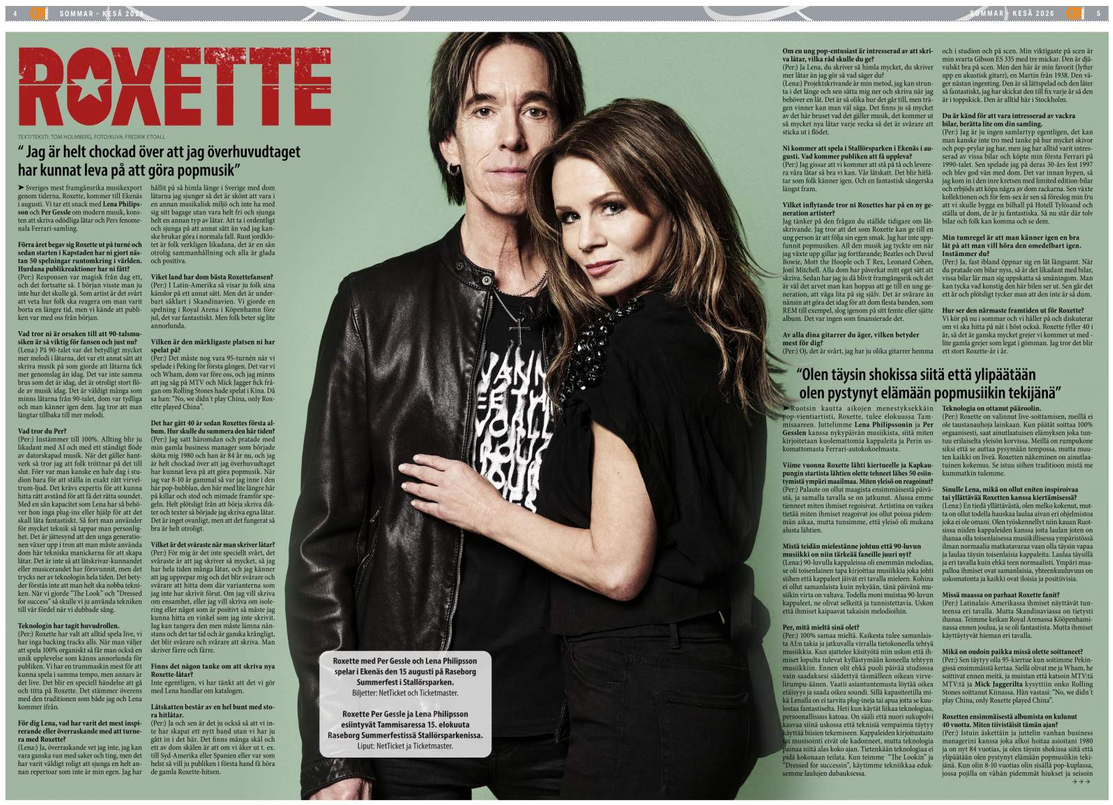
Photo by Fredrik Etoall