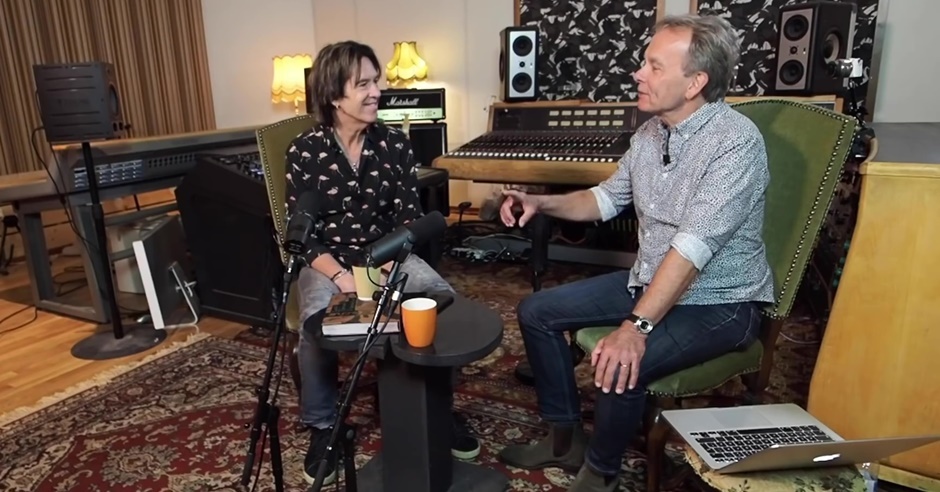
Interview with Per Gessle by Wyborcza, Poland

Jarek Szubrycht from Wyborcza in Poland did a great interview with Per Gessle on the occasion of the Bag of Trix release.

He starts with asking Per about touring with Marie during the past few years. Jarek thinks it was sad to see that Marie, who was bursting with energy in the past had to sit during the concerts. On the other hand, it was touching and uplifting as well, that she didn’t give up. Mr. G says the last tours were a really tough experience. Per asked Marie many times, “Do you really want this? Should we really go?” Her answer was always the same. When Marie told she would be sitting from now on because she had problems with her leg, it was hard to believe for Per. She always ran around the stage and standing still was something unnatural for her. She said she would be sitting because she wanted to sing for the people, she wanted to see them. Per is convinced that the energy she got from the people at concerts and the love they showed for her helped her survive. She was sick for a long time and Mr. G thinks that if they hadn’t gone on the last two tours, she would have left earlier. All the doctors advised her against touring, but she didn’t listen. And if she wanted to go on tour, so did Per. It was all he could do for her, to be with her to the end.

Jarek asks Per if we will ever see Roxette on stage again, maybe with a new singer, or maybe with Marie’s hologram. Mr. G can’t imagine replacing Marie with another singer and he won’t do that. On the other hand, he would feel bad about never performing Roxette songs again. He considers touring with several female singers and tries to find a solution that works both on an emotional and musical level.

Jarek is curious why Marie and Per joined their forces while they both had separate careers. Mr. G tells they have been friends for years and they shared a dream to break through outside Sweden. Per knew that he could write songs, but he is not an outstanding singer, neither the best guitarist in the world. He believed that with the right voice he could do a lot. Marie, on the other hand, felt great on stage and sang perfectly, but she couldn’t take care of the repertoire herself. She needed Per’s songs. In their case, 1+1 made 3 and they were much better together than they were apart. Roxette’s debut album was a huge success in Sweden, but only in Sweden, so Marie’s label urged her to stop working together with Per and focus on her solo career. Marie was persistent enough and fought with them for Roxette’s survival. After achieving international success, they were unstoppable.

According to Jarek, Roxette is a pop band on the radio, but a rock band on stage. Per says Roxette’s strength was great concerts. They put together a really good band and Marie was not only a great singer but also a stage personality. And they put the emphasis on the strong guitar sound on stage.

Regarding Bag of Trix Per tells it’s not a greatest hits compilation. They have already released many such compilations and you don’t need another one. He was browsing Roxette’s archives and to his great surprise, he discovered a lot of recordings that he had forgotten about. Among them there are demos they recorded in a cramped basement in the southern part of Stockholm, still not sure how to divide the roles, how to choose the key, but already very curious how they will make music together. They felt that something special was happening. Per says he also has some great live recordings from the Joyride tour in Australia and he will definitely not keep them to himself.

The biggest surprise for Mr. G on Bag of Trix was Soul Deep. It was to be the first single when Joyride was released in the US and producer Tom Lord-Alge pulled the song more towards soul. In the end, Soul Deep never became a single and even Per himself is not sure that he had heard this version before. He was happy to discover it now.

The warmest memories related to any tracks on Bag of Trix is the Abbey Road Sessions. PG says he couldn’t stop smiling when he listened to it. When they released Don’t Bore Us, Get To The Chorus! in 1995, their label organized a promo concert for them in London. The day before, BBC invited them to the Abbey Road Studios to play some acoustic songs for them. They couldn’t refuse because they were huge fans of The Beatles. Marie said they should do something from The Beatles and since she always loved Help!, they did that cover and it worked out fine. Marie’s voice did all the work here.

Jarek asks if these memories are painful for Per. Mr. G says it’s not painful anymore, but when he was digging in the archives, it happened that he felt melancholy. He tries to remember only the good times and think about the magic that worked in Roxette. They managed to do something amazing, they were really lucky. Thanks to Marie – as a singer, but also an extraordinary personality – Per’s songs became better than they were. It’s not easy, because every day something reminds Mr. G of Marie and he knows it will be like that for the rest of his life, so he has to get used to it somehow.

While Jarek was listening to the demos of Roxette’s great hits, he wondered what distinguishes a good song from a great one that millions of people would later consider their own. Per tells that every time you try to do it the best you can. You follow the music, combine the melody and the words. He thinks there is also temperature and color of each song. He can’t predict which song will make the masses happy and which will get lost, but sometimes in the studio he hears that a new song has something special about it. This was the case with The Look, for example. When they recorded it, they were just one of the many Swedish bands that would like to play a little overseas. But in the studio, when they played The Look to people, they saw that they reacted differently than usual, that this was a song that had that notorious X factor. With Joyride and Milk and Toast and Honey he felt that too. Such songs write themselves, Per thinks. He knows immediately where he is going and how to get there. It’s a special feeling because usually he has no idea what he wants and the music guides him. Sometimes he gets stuck and he knows it’s sometimes better to leave it then and do something else.

Jarek asks Per if he thinks a career like Roxette’s would be possible to achieve today. Mr. G thinks it’s possible, but unlikely. The labels work completely differently, album format is history, radio has changed too much and social media has appeared. Per says pop music has always been a mirror of its era and it is also today. Most mainstream productions are made on laptops, using the same software, so they all sound great, but it’s difficult to tell them apart. Once upon a time, there was no doubt about who recorded which song, you could tell it by the sound. It doesn’t work like that anymore. Computers made everything similar. But the same thing happened with our lives, this is the modern world. On top of that there is an overproduction of music. 40,000 new songs premiere on Spotify every day, which means that new bands hardly have a chance to be noticed by anyone.

Jarek thinks that kids absorb and remember everything, but the older generation already have their idols and are not too open to new ones. Per tells his son is 23 years old and listens to music non-stop, and so do his friends. But they have no idea what the artists are called or what the titles are. Music just comes and goes. When Per was their age and he managed to get money for a new album, not only did he listen to it all the time, but he also studied every detail of the cover, learned the lyrics by heart, he even knew the serial numbers of the albums. He bought releases by specific labels because he knew he could trust them that he would like everything they released. This world is long gone. Mr. G is sorry for that, but his son is not sorry because he doesn’t know what he has lost.

Jarek is curious about when they felt that Roxette’s success exceeds their expectations. Per says they dreamed of touring Europe. To go to Germany, the Netherlands and Belgium and play in a few clubs. They couldn’t imagine much else, even success in the UK didn’t seem possible to them. Meanwhile, the first country where they achieved success outside Sweden was the US. Nobody heard anything like that, nobody understood it. That’s why everyone in America decided they were single shots, that they made The Look, but that was it. Their second single in the US was Dressed For Success and the biggest radio network refused to play it. They decided that since they had already played one track of these Swedes, as a curiosity, they would not play a second one. That’s why Dressed For Success peaked only at No. 14 on the Billboard. Fortunately, the next single was Listen To Your Heart and then everyone gave up and was waiting for their next album with open arms.

Jarek mentions ABBA, Roxette, Europe, Max Martin, successful Swedes and is curious about how it’s done. What do Swedes know about popular music that Poles don’t? Per tells in the 80’s, when music became digital, everything changed. When he was recording his first album in 1979, all Swedish music sounded awful. His music too. Only ABBA was the exception, they always sounded fantastic. After the digital revolution, with the spread of synthesizers and music software, everything changed. Productions from Munich, Buenos Aires and Stockholm began to sound more or less the same as those from London. Swedes have always liked new technologies, so a whole generation of producers and songwriters who could use these tools quickly emerged. This, however, doesn’t explain the success of bands such as Roxette, Europe, The Cardigans or The Hives. So Per thinks maybe the point is that northern Europeans – not only Scandinavians, but also northern England or Scotland – have an innate talent for composing beautiful melodies.

Thanks a lot for the hint, Tomasz Wysocki!

Per Gessle and Tommie Haglund write music together

As Hallandsposten informs, Per Gessle and Tommie Haglund write music together. Tommie Haglund represents classical music, he has composed chamber music, works for orchestra and for choir. For the song the guys cooperated on, Per has written the lyrics and Tommie has composed the music. The title is Making Something Out Of Nothing and it’s about getting older and looking back on your life and the choices you made.

Once it’s possible to organize events again, the song will be on the repertoire of the Tommie Haglund Festival. Due to Covid-19, it will happen only in spring 2022. Founders of the festival are producer Anders Wilhelmsson and Joachim Gustafsson, conductor and artistic manager. Lars Nordin is involved in marketing and design.

That Mr. G came into the picture was because both he and Tommie felt that they wanted to try something new. Haglund says he and Per lived in parallel universes musically, but they have the same bottom. Lars says it’s fun that both Tommie and Per live in Halmstad, they were born three days apart, Per on January 12, 1959 and Tommie on 15th January the same year and they have both made an incomparable international career in their respective genres.

The first text Per sent didn’t really fit Tommie’s music, but Mr. G sent another almost immediately and that one just flowed into Tommie’s music, as he says.

There will be an album recording together with the Royal Philharmonic Orchestra in Stockholm and it’s already decided that Emmi Christensson will sing the song both on the album and at the festival in 2022. Lars informs Hallandsposten that she has a fantastic voice and has, among other things, played the lead role in The Phantom of the Opera in London. Her relation to Halmstad is that she attended the high school there.

After Per listened to the song, he sent an SMS to Tommie telling that he thinks it sounds fantastic. You travel in time and sometimes end up in old black and white 40’s movies, sometimes in a Bacharach romance, but usually in Tommie’s own wonderful musical rainbow. Per thinks it’s a feast for the brain and heart, Hallandsposten writes.

Photo by Lars Nordin

Update on 8th August 2021: As Tommie Haglund informs, Making Something Out Of Nothing will be recorded on 1st September 2021 with Emmi Christensson soprano and the Royal Stockholm Philharmonic Orchestra conducted by Joachim Gustafsson. It will premiere live at the Tommie Haglund Festival on 23rd April 2022 in Halmstad with the Bogotá Philharmonic Orchestra.

Update on 1st September 2021: Hallandsposten informs that ”Making Something Out Of Nothing”, a song by Per Gessle (text) and classical musician Tommie Haglund (music) is being recorded today with Emmi Christensson soprano (who is very excited about the recording and says it’s a very beautiful and emotional piece) and the Royal Stockholm Philharmonic Orchestra conducted by Joachim Gustafsson (music director of Bogotá Philharmonic Orchestra). It will be played live at the Tommie Haglund Festival, 21-24 April 2022 in Halmstad. The song will be released on vinyl with Emmi singing on side A and an instrumental version on side B. It’s out for the festival. Tommie tells that the piece will premiere in March next year internationally in Bogotá, Colombia, by the city symphony orchestra. Many suppose that it will then be Colombian world star Shakira who will sing.

Per Gessle podcast interview by Rhino

Rhino is the catalogue development and marketing division of Warner Music Group, founded in 1978. They started a podcast series in 2018 and hosts Rich Mahan and John Hughes now welcomed Per Gessle in it. Listen to it HERE!

Per talks about the times Marie and he met, the story of their break-through in the US with The Look and how things changed after that. The guys also talk about Listen To Your Heart, touring, playing large venues, as well as Per’s Los Angeles adventures with Anders Herrlin in 1981. It Must Have Been Love is also popping up of course, as well as the recordings of Good Karma. Rich, John and Per discuss Roxette being a power pop band and Mr. G talks about Bag of Trix too, where he shares details about Let Your Heart Dance With Me and Piece of Cake. The guys talk about EMI and several Roxette albums, as well as Per’s other music projects like Mono Mind or his Swedish band, Gyllene Tider. Per talks a bit about his latest Swedish solo album too, as well as songwriting. The podcast ends with talking about Marie, how she made Per’s songs much better and how she made the songs her own.


Stills are from the podcast episode teaser.

Marie Fredriksson – Sea of Love

It’s 9th December and it has been a year since Marie Fredriksson passed away. On the anniversary, the single Sea of Love is released on the family’s initiative to honor the memory of Marie. This is the last song Marie recorded.

During Marie’s final years, she released a series of singles that were close to her heart; the jazz ballad Alone Again (2017), the blues cover I Want To Go (2017) and the big band ballad Sing Me a Song which was released in 2018 in connection with Marie’s 60th birthday.

Sea of Love was inspired by the demonstrations in Stockholm after the terrorist attack on Drottninggatan 2017, and the sea of people who stood up for love and reconciliation.

Listen to Sea of Love HERE.

Sea of Love

Like a sea of love, of love

You and I, me and you
You’re so strong and I’m so blue
Close to you I feel the sun
One for all and all for one

Place yourself in a world
Where every voice could be heard
Not just me, not just you
But all of us like a sea, sea of love, of love, of love

I woke up in a dream
We were one just like a team
We marched together with a common goal
Peace in mind and in your soul

Free to live your only life
Without hate and with no strife
In a world where we could live
Side by side like the sea, sea of love, of love, of love

You and I, me and you
You’re so strong and I’m so blue
Close to you I feel the sun
One for all and all for one

Composed by Mikael Bolyos


Per Gessle interview on Nordmark Pod

Per Gessle was Per Nordmark’s guest on his podcast, Nordmark Pod the other day. Per Nordmark is a Swedish drummer and producer.

After Nordmark’s intro talk, the interview starts with Nordmark explaining they greeted each other by bumping elbows because of the pandemic. Nordmark congratulates Per on his new album, Gammal kärlek rostar aldrig and tells it’s altogether 30 studio albums Per has released so far. 10 solo, 12 with Roxette and 8 with Gyllene Tider. Per tells Nordmark exaggerates a bit, because Roxette has 10 studio albums. Nordmark insists on 12, but it’s hard to tell how he counted the number of studio albums anyway. He probably calculated with live or compilation albums as well, in case of GT too.

Per Nordmark tells he was 6 when he first met Mr. G’s music. He was a hard rocker, his sister introduced Kiss to him, but then he bumped into Puls from Gyllene Tider and he was very excited to hear that music. Per says he was also 6 when he got hooked on pop music. It was in 1965. It was The Kink Kontroversy by The Kinks, which his brother played to death. His brother had his teenage friends gathering in his room, listening to music and Per was a 6-year-old baby then. He says 6 is a good age to get started.

The guys are talking about how listening to music changes when you become professional. Sadly, you start listening to music differently. You start analyzing what you hear. Nowadays, when Per is listening to music he is listening to analyze. How did they do this, what did they think there, how strange they changed the chord here, etc. Modern pop music is very far from the 60’s and 70’s style, it’s built on the same chord in the verses and the choruses. Here Per excuses himself for talking too much, but Nordmark encourages him to go ahead. PG says one can ask why you liked the intro in I Feel Fine by The Beatles, if there was anything special in it [here Per demonstrates how the intro sounds] or why you liked The Who’s drum sound. Things like that. Per thinks it’s the romance in pop music what people like the most. Pop music’s position was much bigger and stronger back then than it is today. Times are changing. When pop and rock were blooming in the 60’s, there was an after-war generation. Music had a different role then, there was a revolution. Now after 50 years everything is more digitalized and you make music in a different way. Per often tells his son’s friends, who are in their twenties that one day they should try and play in a band. 4-5 people get together, pick their instruments and learn to play a song together. They should experience how it is to be a piece of the puzzle and realize how good it can sound. You can’t get that feeling in any other way, sitting over your laptop. He doesn’t say it’s wrong, he just says it’s different. The creative, organic feeling of piecing the puzzle together is fab. Nordmark says his father is a drummer and he also advised him to play in a band.

Nordmark says he loves playing live, but rehearsing is not his thing. Per says he loves playing live too, but he also loves rehearsing. When they toured with Roxette or with Gyllene Tider, lately they usually played their greatest hits. It’s less risky. But before a tour you are rehearsing songs that maybe you never played live before. They are fun and you might add 1 or 2 of them to the setlist of 25 songs or so. So he thinks it’s exciting to rehearse.

Regarding his new album, Nordmark asks how we should imagine the process, how it was created. Per tells it started with writing two new songs in spring when the pandemic started. The songs were Mamma and Pappa. They were released on a single for Mother’s Day. The idea was to play all the instruments himself and Helena Josefsson came to sing as well. Then he thought it wasn’t bad and since there was isolation, he thought he would record some more songs in the same way. At the same time he was writing an English album, so he was in his English songwriting bubble and he didn’t have the feeling to write a new Swedish album. Then he realized he had many old songs he didn’t release before or others he thought would deserve a better recording. So he was digging in his archives and found demos and also songs he wrote for other artists. He also found Kom ut till stranden, the only song from his never recorded third solo album that wasn’t translated into English for Roxette’s debut album. He always liked that song, but now he realized how clumsy the lyrics were, so he rewrote it. After 4-5 songs he realized that he can’t play all the instruments himself. He is a lousy bassist and an even worse drummer, so Jens from Brainpool came and played the drums and he also looked for musicians in Halmstad. He found ”Gicken” Johansson who is a fantastic bassist and he became one of the most important part of this project. Then he thought to include the most untrendy instruments in pop music, e.g. saxophone. He knew a very talented jazz saxophonist in Halmstad, Per Thornberg, so he came and played on 2 songs. Then most of the other instruments PG played himself.

Nordmark is curious about how Per saw his own songwriting during this project, how it was in the 80’s and how it changed. Mr. G says he realized he wrote longer songs in the past, he has become more effective. He thinks it came automatically. The intro can be more effective, the outro doesn’t need to be too long. Things like that. He also discovered that when new musicians join him he realizes the small details in his songwriting of the 80’s. For example when bassist Magnus Börjeson, who is like Roxette’s Ron Wood, plays Roxette songs, e.g. The Big L. Or he realized that there are changes in the keys 5 times in (Do You Get) Excited? That was his style back then. He became more sophisticated and it resulted in writing simpler in a way.

Per thinks music is the best there is. Even more than that. He is his music. He lives for his music, he wakes up with it and goes to bed with it. He is always thinking about ideas, solutions of musical problems or text problems and he is very much affected by it. He can’t communicate until he solves his musical problems. Åsa always says it’s like he is giving birth. He can be very anti-social then.

Per thinks music has a huge effect on people. One of the things he and Marie always talked about is that they were so lucky to travel around the world, to different places with different religions, different languages, different cultures, but everyone liked their songs. It Must Have Been Love or Listen To Your Heart, they broke through all barriers. It’s the power of music. Music makes you happy or it makes you want to dance or cry. A lyric of Leonard Cohen makes you break down because it’s so strong. Not too many arts have this same effect. Per thinks if he was a painter, his utterance would be the same, because art for him is about expressing himself. For him it was pop music he got hooked on already at an early age. He wanted to belong to a band, he wanted to play, he loved everything related to it. He also had a huge need to express himself in a way. He could have been a novelist or a journalist or a painter, but he became a pop musician. He thinks pop music is a lovely format. It’s quite short, but he likes that one can create different temperatures, the lyrics have different temperatures or colors, most often there are 12 or 16 lines and then it’s over. He just heard on TV that the one who won the August Prize was writing her book for 10 years. Per thinks he would have died, dealing with the same project for 10 years. He usually wants to finish his project as soon as possible, so he can start a new one. He likes to finish the songs in the studio and then mix them, not to let them lie around for another 2 months. There is also a restlessness in him of course, but he tries to use it for something positive.

Per says he tries to work as little as possible, he doesn’t sit down every day to write. If he has a project going on, like his English uptempo album now, he is working on that when he feels like it. He still likes to think in album format, so he is writing 12, 15, 20 songs before he goes to the studio. In the studio he wants to focus on the whole project. If you are working with 5-6 songs at the same time you might realize that some ideas don’t work on this or that song, but they would work on another. The music industry is very song-oriented these days, rather than album-oriented. Why to release an album, why not only one song at a time? Per says he doesn’t work like that. Nordmark says he talks to a lot of young musicians and their dream is still to release an album. So musicians still think in album format. Per says most people in the pop world dream about it, but they work in a different way. They work on a song-by-song basis and it’s because nowadays it’s very hard for a new pop artist to be there for a longer time. And you can’t build your future on 3 albums or you can’t tour with 2 songs. Also, there are 7 people writing one song. So it’s very hard to build up a classic pop or rock career. Those who are there on the live scene are usually older artists. They are the ones who have a big enough catalogue. U2, Bruce Springsteen, AC/DC, Bon Jovi, Depeche Mode, The Rolling Stones. It’s hard to compete with them if you release only one song at a time.

Nordmark says Per already had success with Gyllene Tider before Roxette broke through and he is curious if Per remembers the feeling of „shit, it’s 2.0, it’s happening again”. He is also curious if Per had the self confidence as a songwriter back then. Mr. G says when GT was over in 1985, he had no career left. He wrote songs for other artists, but it didn’t really fit him. He is not the type of a hired gun. It was always hard for him to compromise. So he was very happy and thankful that Marie, in the middle of her blooming solo career, wanted to do a project with him. Her producer and EMI didn’t want her to work with Per, so that Marie wanted it it felt fantastic for Per. His self confidence was not the strongest then. The first Roxette album was made of the songs he wrote for his never released third Swedish solo album. He translated the songs into English and their debut album became a success. They also went on tour. The only thing that made Marie continue to work with Per was to break through abroad. In Sweden she was already a big artist with her solo songs. Per was a catalyst, but both of them were very ambitious. After the first Roxette album, Marie made another Swedish solo album and during that time Per wrote songs for Look Sharp! Then he still didn’t have much self confidence. Look Sharp! came out in autumn 1988 and they released the first single from it in summer 1988 in Sweden. It was Dressed For Success. They went on tour in autumn, they played ice halls and they released their second single, Listen To Your Heart. In January 1989 they released The Look as a single and later the US break through happened. Before that, no other countries wanted to release Look Sharp! No EMI Germany, France, Spain, Canada or Australia, no one. The music industry was very much focused on the US and the UK, so after The Look became No. 1 in the US in spring 1989 and they wanted to release it in the UK too, their record company told Roxette was an American band. Otherwise they wouldn’t want to release a Swedish band’s material in the UK.

Per says he was motivated by success. He got evidence that there are more „idiots” besides them two in the band who liked what they were doing. He laughs. Nordmark laughs too and says actually, there were some millions of idiots who liked it. Per says then he gained self confidence from the fact that people liked their songs. Then he had the same feeling as when he got his first fan mails as a 20-21-year-old from Gyllene Tider fans. It was incredible to get mails from unknown girls. He laughs. Per also tells that when they recorded Look Sharp! he thought if they succeed with one of the songs somewhere in the world then they have a great career in front of them, because they had very strong songs on that album. Paint, Listen To Your Heart, Dressed For Succes, Dangerous, The Look, Dance Away, Sleeping Single, so the whole album was very good for the pop music of the time. At the same time, they were very humble and they were completely shocked when the break-through really happened in the end. It was of course unbelievable.

Nordmark asks Per about The Look, how Per wrote the lyric to it. Per starts with telling that the first Roxette album was recorded with musicians their producer, Clarence Öfwerman chose. It was a great band: Tommy Cassemar, Jonas Isacsson, Pelle Alsing. For their second album, Per started writing demos in a different way. He started working on snyth and started programming. He wanted to go to a little different direction in style. He bought a new synthesizer, an Ensoniq ESQ-1 and he wrote two songs on it. The Look and Don’t Believe In Accidents. The Look is a 3-chord song, A, G and D. To remember the melody, he came up with a nonsense text. He was just humming it on his tape recorder and later he thought it sounded damn cool, it was a bit like The Beatles’ I Am The Walrus. So he kept it. Per thinks there is some kind of surreal logic in the lyrics. Originally, the text was „he’s got the look” though, because he wrote it for Marie to sing, but she didn’t want to. She thought the melody was too minimal for her. So she sang nanananana and then replied to Per in the chorus. That’s how it became „she’s got the look” in the end. Nordmark is curious what kind of drum machine they used in The Look, if it was LinnDrum. Per can’t remember, but he knows that the sequencer he used already on his demo too. An Ensoniq sequencer that was on the synth.

Talking about texts, Per finds it cool that you write a text and suddenly it starts to communicate. He gets mails and messages from people that they got married to this song or met while that song was playing and it means so much to them etc. So by interpreting the text, it becomes part of their lives. He writes the songs for himself or he writes it out of himself, no matter if it’s a true story or not and then when it starts to communicate with other people, it’s crazy. It’s fantastic. That’s also pop music’s power that the lyrics and the music have such an effect. It makes you feel that it’s a story of your life.

Nordmark asks Per about his experiences regarding touring, if he likes touring. Per says he always liked touring, but he never considered himself being a fantastic artist on stage. One shouldn’t forget that he started to sing in Gyllene Tider because no one else wanted to. The guys are laughing and Per mentions Micke Syd sings nicely though. He liked the idea of Marie singing. Already in the beginning she had the potential of becoming a fantastic artist on stage and she has always been a fantastic singer. There were only advantages of working together with her. Then of course when they broke through with Roxette, it was fun to communicate with the crowd. It’s the best there is to stand on stage in front of 5, 10, 15, 20, 30 thousand people who love what you are doing and they sing along a song you wrote, in cities you can’t pronounce the name of. Nordmark says he saw a documentary about Roxette where they were on tour in South America and he saw there were a lot of people. He is curious if Per ever thought, „shit, it’s too much”, because being an idol can also have its discomfort, he thinks. Per says Roxette’s heydays were between 1988 and 1995, before Marie had her second child. During those 7-8 years they travelled around the world, made albums, promotions, they toured. Per thinks when you are in the middle of it all, you don’t start thinking if that’s too much or if it will ever end or if your creativity burns out one day. You just want to keep going. You also don’t think in a way that shit, today there were 58 thousand people, tomorrow there should be 62 thousand. You are just doing your job. South America in 1992 was a quite bizarre experience, with police escort and stuff. The other day, the media in Argentina did interviews with him, they talked about Bag of Trix, their recent release and they were still talking about that tour in 1992, that they never experienced such pop hysteria since then. That was another era. When they played in Córdoba, which is maybe the third biggest city in Argentina, there were riot fences set up between the airport and their hotel, for example. It wasn’t a long distance, maybe 15 kilometres. There were a lot of fans with flags and banners all the way. Marie and Per were sitting in the car, they were let out at their hotel and then after they played, they travelled to another city. They went to Tucumán, which is also in Argentina. There had never been any rock bands before. They played there for 25-30 thousand and there were people climbing up even the light panels. He remembers the crew was desperate, he laughs. He says it was a fantastic tour and he’ll never forget that.

Nordmark asks Per if they were nervous before performing. Per says of course they were nervous, that’s natural, but you get focused. There were big TV programs in the US, they were live on The Arsenio Hall Show, for example and of course you are nervous, because anything can happen when you play live and there are 80 million people watching it. He thinks it can be the same for professional soccer players. They play matches in front of 40, 50, 60 thousand every time, so they become immune in a way. Mr. G says there is no difference between playing for 1000 or 30 thousand in that sense. You learn how to communicate with the audience. Marie was a master of it. She learned it very fast how to handle the crowds of different sizes. PG thinks Mick Jagger and Rod Stewart are very good examples too, just watch some videos of them on YouTube. Springsteen’s communication with the audience is also fantastic.

Nordmark says he read it somewhere that when Per was a kid he went to see Peps Persson [Swedish blues and reggae musician]. Per says he never saw him, so it must have been someone else Nordmark read that about. When he was a kid he went to see 10cc, AC/DC, they were the support act to Black Sabbath, Tom Petty and The Heartbreakers, they were the opening act for Nils Lofgren. They went to Gothenburg or Lund to attend concerts.

In Halmstad there was a vivid music life in the 60’s, before Per’s time. The Who was there, The New Yardbirds before they became Led Zeppelin, The Spencer Davis Group, The Hollies. Per’s brother went to see them all, but back then Mr. G was too young to be able to go. He remembers he saw Rainrock with Pugh Rogefeldt, he also remembers an incredibly sleepy concert of Ekseption, a Dutch classical rock band. When you saw them you realized you don’t want to be a musician. Sex Pistols played at Östra Stranden in Halmstad maybe in 1978 [it was in 1977]. Mats MP Persson and Per jumped into MP’s white Amazon and wanted to see Sex Pistols, but there was such a big fight outside the venue that they didn’t dare to get out of the car and they left.

As a closing topic, Per talks a bit about his English album. He says it’s almost ready. He has been working on it since spring. He goes to Skåne to the studio and they work 4 more days on it. Mr. G thinks it’s an exciting project. Per says he works together with Christoffer Lundquist, Clarence Öfwerman, Magnus Börjeson and also Jonas Isacsson on it. During the past few years he made so many singer-songwriter stuff that now he decided to make some pop of the 80’s or early 90’s that he loves, but didn’t deal with it since long. So he wrote much music in that style.

Nordmark thanks Per for being his guest and Mr. G says it was nice being there and it was a good chat.