Kjell Andersson, former Head of A&R and producer at EMI Sweden publishes his autobiography, Ingen går hel ur det här – Mitt liv i den svenska musiken on 8th February. Over 40 years in the music industry, Kjell worked together with many of Sweden’s greatest artists. To name a few: Per Gessle, Gyllene Tider, Marie Fredriksson, Roxette, Mauro Scocco, Eva Dahlgren, Wilmer X, Björn Skifs, Ulf Lundell etc.
Besides the book, an album is also released where Kjell’s artists offer interpretations of mainly each other’s songs. What a cool idea to create an album like this! Title is Ingen går hel ur det här – Sånger från Kjell Andersson’s liv i den svenska musiken. You can listen to it HERE(after midnight your local time)! It’s very probable that this is a digital release only.
Tracklist (songs related to Marie or Per are in bold)
Plura & Mauro Scocco – Nånting måste gå sönder
Magnus Lindberg – Jag saknar oss
Mauro Scocco – Ljusterö
Andreas Mattsson & Tomas Andersson Wij – Landsvägspirater
Johan & Jessica – Vägar
Peter Lemarc – Sara-Li
Per Gessle & Helena Josefsson – Sniglar oh krut – original: Ulf Lundell (1975)
Basse Wickman – Spelmannen
Marie Fredriksson – Här och nu – original: Basse Wickman (1988)
While the recording of Per’s Lundell cover sounds recent, Marie’s recording of Här och nu is most probably from the end of the ’80s, judging by her vocals. Great to hear something so far unreleased by her! Per and Helena sound very authentic on the Lundell cover. This song would well fit the En vacker… sessions in their interpretation.
Covering a Marie song is always a challenge, I would say, and it’s very interesting that all 3 songs of hers are covered by male artists on this album. Triad (Niklas Strömstedt, Lasse Lindbom, Janne Bark) did a great job by interpreting Den sjunde vågen and Niklas Strömstedt’s cover of På väg is also very nice (he wrote the music to it anyway). Niklas already released this song as a duet with Per on his En gång i livet album.
Kjell’s book will for sure be an interesting reading as well!
Update on 9th February 2021:Unfortunately, both Marie’s and Per’s cover disappeared from the streaming sites. Per says: “There was a misunderstanding concerning the master rights to the songs. I’m sure “Sniglar och krut” (and Marie’s song) will pop up somewhere else down the road.“
In the Nr. 3 2020 issue of Cancerfonden’s magazine, Rädda Livet(Cancer Foundation, Save Life), author and journalist Helena von Zweigbergk writes a chronicle about her friend Marie Fredriksson, how she admires her way of dealing with the difficult.
The title is Strong, stubborn, warm Marie. Helena tells that in December 2019 she got a phone call from some newspaper or radio or TV program while she was on her way to a studio for recording the reading of a book she had written a long time ago. The caller wondered if she had heard that Marie Fredriksson passed away. Helena remembers the wording, ”passed away”. She knew what it meant, but couldn’t process. She asked „where?”, to pull herself together and push the call away. There was no way she could tell anything. She knew it would happen. Helena and Marie had seen each other not too long ago and that meeting is stored in Helena’s private innermost being. Still, the news was shocking for her.
When they met to talk about writing a book together, Marie had a strong desire: ”People need to know what it’s like to be part of such a thing I’ve been through,” she said with the eyes filled with tears. She could be in despair, have angry tears, but always wiped them away with determined hands, Helena says. Then came what felt like Marie’s constant mantra: ”But it gets better. You have to think positively. It gets better.”
Helena could look into Marie’s expressive eyes and wonder how she could emotionally deal with being invaded by the evil forces of brain cancer. Marie was a fighter, Helena always thought so and said that many times, and she is not the only one. Marie’s struggle was not only physical survival, but also mental. To never let go of hope. Helena thinks one can say that it ended unhappily physically, but not mentally. She thinks hope and light were with Marie all the way and Helena is glad for Marie’s sake, that she managed to keep it.
Another friend of Helena who suffered from severe cancer, but survived, told her that she felt unsuccessful because she didn’t feel enlightened or closer to life than before. That she just thought it was awful, that she was mostly angry and didn’t feel like an admirable fighter at all, even though of course she was.
According to Helena, few things require as much courage as starting to approach one’s own or a loved one’s end. She can really understand someone who doesn’t have the strength or maybe even wants to be stoic on the road. Then at some point you should be able to turn your attention completely inwards.
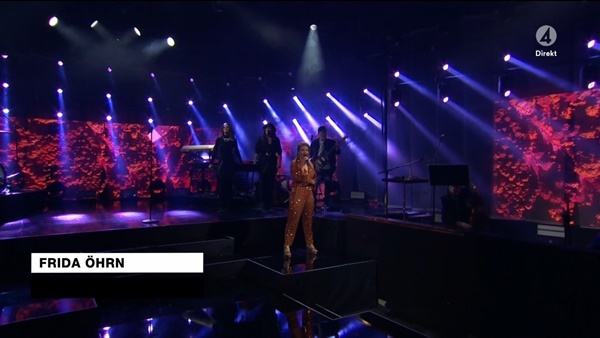
There was a 2-hour-long live music gala on TV4 tonight, Don’t Stop The Music. The evening was arranged by the Swedish Music Foundation, which works to support everyone in the music industry who has been affected by the pandemic in various ways.
Among other artists, Peter Jöback, Tomas Ledin, Zara Larsson, Lars Winnerbäck and First Aid Kit performed at the fundraising gala.
Such an event in Sweden can’t happen without at least covering Roxette. This time it was 4 great Swedish ladies who performed Roxette’s four US No.1 hits in a medley. It started with Janice and Listen To Your Heart that turned into Frida Öhrn’s interpretation of The Look. Then came Mariette with Joyride and Loreen closed the medley with It Must Have Been Love. Click HERE to see their performance. Before the medley, there was an intro talk about Swedish US No. 1 successes. Four of the seven No.1s were Roxette songs.
Dea Norberg was at the gala too and she provided backing vocals. She was also interviewed by TV4. She is a singer and backing vocalist and she has been touring for 25 years. She tells the music industry is in a difficult situation during this time. Dea says she wants to feel that she can contribute to the society with the skills she has. She hopes and believes that all on stage and backstage will survive this tough period. She represents thousands of those who we don’t see, but who created what we see.
Per Gessle contributed to a book, The Beatles – Album by Album: The Band and Their Music by Insiders, Experts & Eyewitnesses, published in 2019. It’s an original telling of the Fab Four’s story. This informative work tells the story of John Lennon, George Harrison, Paul McCartney and Ringo Starr from the band’s formative days in Hamburg to the split in 1970.
General Editor is Beatles insider Brian Southall, a former Press Officer at EMI (dealing with the Beatles’ solo projects) who began writing about music in the 1960s on a local newspaper. He published his first book – the official history of Abbey Road Studios – in 1982.
For this book, Brian gathered a team of experts – including former Apple Records CEO Tony Bramwell, singer Steve Harley, Sir Tim Rice and producer Chris Thomas – to write about each of the band’s record releases, from Please Please Me to Let It Be.
The English edition of the book is available HERE for example, but it’s also published in other languages.
It’s a very informative and well-edited Beatles book including tons of photos from studio sessions, live appearances, travelling etc. You’ll find info about each one of the Beatles albums including what the Beatles said about them and also what the critics said. Very enjoyable reading not only for die-hard Beatles nerds.
Per talks about the Beatles quite often in interviews and he can’t really put together a podcast top list of his favourite songs in different topics without adding a Beatles hit. His love for the Beatles’ music is neverending and even if you might have heard most of what he tells in this book, it’s always great to read his enthusiastic thoughts on music.
Picture of Per Gessle published in the book
PG about Rubber Soul
Per says in the book that he loves the sleeve because he loves John Lennon’s jacket. He has the cover picture by Robert Freeman in his office. He thinks the album has a very cool title.
’Norwegian Wood’ is one of my favourite tracks, then ’Think For Yourself’ with the fuzz guitar and ’Girl’ because of that magic Lennon voice. There were three writers but there were also three singers, which meant you never got bored with their sound.
Per thinks maybe the reason they were able to do all their music in such a short time was because there were three generators. They had so much energy and so many ideas that maybe they just had to pour it out. Per says in the book that we will never see that sort of output again in our lifetime. He also adds that pop music’s essence is to reflect the era when it is born.
PG about Revolver
I always say 1966 is the best year for pop music – and that’s because of ’Revolver’, which is such a great album. ’And Your Bird Can Sing’ is my favourite track and ’Taxman’ is such a great song. ’Here, There and Everywhere’ was played at my wedding; and they make it sound simple but if you try to play it, it’s really complicated.
In the book Per shares that he thinks it’s almost a perfect album and loves the sleeve by Klaus Voorman. He thinks this one is much heavier than Rubber Soul and it’s the last album where the songs were classic Beatles pop music but still had that edge in the production and the sound.
The guitar sound is heavier, it has much more rock to it than ’Rubber Soul’, which is much more of a pop record; and I think that’s what appeals to musicians and writers about ’Revolver’ – the hardest thing to do as a writer is to come up with a great pop song and make it raw, make it rough.
Mr. G tells in the book that in 1981 Gyllene Tider was the biggest band in Sweden and they released a special EP with four cover versions including the Beatles And Your Bird Can Sing, which he translated into Swedish and thinks it sounds really terrible. They tried to make it similar but weren’t capable. [GT’s cover is ‘Och jorden den är rund‘ from the ‘Swing & Sweet’ bonus EP to ‘Moderna Tider’. /PP]
We were in our early twenties and it was just like a throwaway thing – you could do that back then, just after punk and new wave – but today you can’t really touch that stuff.
PG about Sgt. Pepper’s Lonely Hearts Club Band
In the book Per tells wherever you went, when it was released everyone played it, no matter where it was. It doesn’t happen today with any artist.
PG about The Beatles (The White Album)
Musically, I remember ’The White Album’ the best as I was nine years old. It was just an amazing record. It was so mesmerizing. I was really into pop music very early on because I had an older brother who showed me around pop music. I must have first heard it when it first came out: my brother would have bought it when it came out.
Per tells the author The White Album was so cool and Dear Prudence is his favourite song. He also always loved Cry Baby Cry.
There is some rawness to that album that is very appealing to me; and it felt like it was a wild album after ’Sgt. Pepper’ was more controlled.
Mr. G says in the book that everything about the album was special. He mentions Richard Hamilton’s white sleeve and the fact that it wasn’t too common to have lyrics printed with the album. Since English is their second language, being able to read the lyrics while hearing it was great.
I still have an original numbered album. The cover is a blank page and it goes so well with what the album is all about – it’s a blank page and was so different from ’Sgt. Pepper’.
Per thinks it was a magical record that opened up your imagination a lot. Not releasing any singles from the album is the opposite of how it is today and how it was in the fifties when it was all about singles.
Mr. G tells in the book that Benny Andersson from ABBA said once to him that the only song that he wished he had written was Martha My Dear and Per can understand him very well.
To be able to write and play it you have to have a certain musicality that you can’t really learn, it has to be inside you.
He adds:
The track ’Revolution 9’ was unbearable when you were nine years old but looking back it was the perfect follow-up to ’Tomorrow Never Knows’ and ’A Day in the Life’. Back then you had never heard anything like it before and that was obviously the only track you skipped when you played it.
Per says in the book that the production on The White Album is much more raw than Sgt. Pepper.
There is a hint of studio tricks but there’s also ’Helter Skelter’, which is like a jam session and ’Back in the U.S.S.R.’, which they could have played live just the way it was recorded.
Per Gessle was one of the guests on Nyhetsmorgon, TV4 this morning. He entered the studio after Jubël (Sebastian Atas and Victor Sjöström), a Swedish duo originating from Halmstad performed their song, Someone. Per mentions how good they are and shows thumbs up to them. Program leader Jenny Alversjö asks Mr. G if they worked together and Per tells that for example, in 2018 they wrote music together for Name You Beautiful, the official song for the World Table Tennis Championship in Halmstad.
Jenny asks Per about Christmas. PG says it was calm of course. It’s been a quite long, boring time for everyone, Per thinks. Then Jenny tells there was the Late Night Concert on TV4 in December and it came as a consolation in the darkness when we needed it most. Per tells it was fantastic. They’ve been sitting isolated for such a long time and couldn’t play and even if there was of course no audience for this event, it was fun to rehearse and meet the band. It was fun to play in an acoustic arrangement, he thinks it’s always special. It was like finding new ways for the songs and certain songs fit this intimate format, e.g. Tycker om när du tar på mig or Listen To Your Heart. He tried to pick songs from Roxette, Gyllene Tider and his solo career. It was exciting for him.
Jenny asks how it works not to strip down something that is the core of the song. Per says the core things in his songs are most often the lyrics and the melody, so this way one can even put these elements more into focus.
Here they show some parts of the concert and Jenny tells it was incredibly nice. She asks Per how he picked the songs for this event. For this concert Per says he tested 10-15 songs, maybe more and he simply chose the ones that felt best. One can feel it that some songs just don’t work in a toned-down version. The Look, for example, would have been quite meaningless to be played there.
Jenny tells Per has Billboard No. 1 songs and sold millions of albums and she is curious about Mr. G’s relationship to music today. Per says it’s quite unchanged. Music has always been his thing and he has never thought of music as his job.
Jenny asks Per about his plans whether he is thinking about new things or planning to work with his already existing catalogue in the way we could see him at the Late Night Concert. Mr. G says partly this and that. He thinks he has always had a very good setup: Gyllene Tider, which is a certain type of power pop, Roxette, which is a totally different style also productionwise, his solo stuff, which is more lyric-based, more of a singer songwriter style and Mono Mind, which is also a totally different music. He used to say there are different things on the same tree and it fits him very well, so he can do diverse things.
Jenny asks Per whether he had done everything he wanted to do or there is still something he dreams about. Mr. G says he has no special dream, he just wants to keep going with all what he is doing and wants to see what happens, be curious and test things.
Jenny asks how Per finds inspiration and where his creativity comes from. Per says it’s his way to express himself. He expresses his personality and creativity through music and texts, so it comes by itself in a way. Many think that he ”goes to work” at 9 and plays the piano and the guitar for 6 hours, but it doesn’t work for him like that. He writes down just what he must write down and it’s when he has something that must come out. It can be a melody or an idea or a text.
Jenny asks Per about the secret of being a hitmaker and if he feels it when he writes a song that it would become a hit. Per says it’s been long since the last time he wrote a hit. Pop music has changed so much and he sticks to his roots, so he is not a modern hitmaker anymore. He says there are so many things that have to work for a song to become a hit. It’s not just the song itself, but it’s also about timing, cooperations, luck and a thousand other things that should work at the same time. Regarding certain songs, e.g. The Look, when they recorded it in the studio in the 80’s it felt that it was very special, but that it would become No. 1 in 30 countries, you never know in advance. It Must Have Been Love was a very good ballad and then it became part of the movie, Pretty Woman and it became such a monster hit. Coincidence also plays a big role, Per says.
Jenny mentions Marie passed away more than a year ago and is curious how it is to play Roxette songs without Marie. Per says it’s terrible that Marie is not there anymore, but he feels that the music lives on and he sees that all around the world. He still wants to play these songs, they are such a big part of his life, more than 30 years of Roxette. He doesn’t want to close that door, but it will be different and he will never replace Marie. Jenny asks Per about griefing and missing Marie. Mr. G says it’s a constant feeling. You can never call her or talk to her again. Now Pelle Alsing, their drummer also passed away before Christmas and it also feels incomprehensible. It’s tough.
Jenny says she also knows Per is working in the studio now and is curious what the future brings. Mr. G says he is recording an English pop album and it sounds a bit like Roxette’s origins. It’s a bit difficult to write uptempo pop songs at his age even if he wrote so many of such songs before. He simply took the challange to write an awesome pop record. Jenny thinks it’s very exciting and Per agrees. He has no clue when the album is out, but he plans to release it this year. When it’s ready.