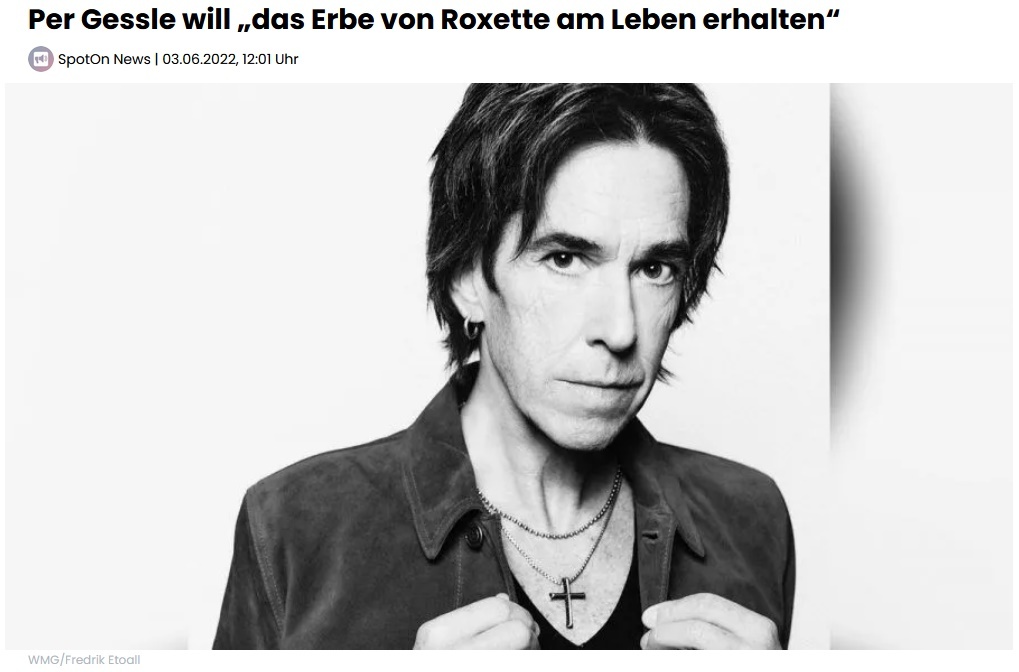
Per Gessle wants to “keep Roxette’s legacy alive” – SpotOn News

SpotOn News did an interview with Per Gessle about PG Roxette. Here you can find the original text in German.

The first single is here! Per Gessle takes off with his new band, PG Roxette. After Marie Fredriksson’s death in 2019, it was not easy for him to decide on the new project, as he explains in an interview.

Per Gessle (63) is back with his new band, PG Roxette. After the tragic death of singer Marie Fredriksson (1958-2019), the cult duo, Roxette was also history, but Gessle is now reviving their legacy with his new project. The single “The Loneliest Girl In The World” is released on June 3rd. It is the first taster of the upcoming September album “Pop-Up Dynamo!”. In an interview with the news agency SpotOn News, Per Gessle reveals how difficult it was for him to decide on the new band. With PG Roxette he wants to “keep the legacy of Roxette alive”.

SpotOn News: Title of the first single is “The Loneliest Girl In The World”. What is the song about?

Per Gessle: Well, that’s really up to you to decide. I never explain my lyrics. That’s the magic of songs, the lyrics mean something different to everyone. I don’t want to destroy that. Sometimes I hear a song that feels like it’s written about me and only me, a song that goes straight to my heart. I keep hearing the same thing from people listening to songs I’ve written. It’s amazing. That’s the power of music. So you have to interpret all my songs yourself, including “The Loneliest Girl In The World”. Maybe it’s about you?

SON: What role does Marie Fredriksson’s legacy play in PG Roxette?

PG: Well she was half of Roxette so she will always be there in spirit and in my heart. She was one of my best and oldest friends. After Marie passed away, I had two options for Roxette. One was to close the door and stop, the other was to keep going. I decided to keep going. I wrote almost every song Roxette ever recorded and it would have felt strange to turn my back on more than 30 years of my life. My goal for the future is to write more music and lyrics, make new recordings, play live and keep the Roxette legacy alive.

SON: Are you still in touch with Marie Fredriksson’s family? Did they support your decision on PG Roxette?

PG: Yes, I know them very well and of course they support what I do. Why shouldn’t they?

SON: What can fans expect from the new album?

PG: I wanted to make an uptempo album based on the sound that’s in my blood and DNA. That’s the sound of the late 80’s and early 90’s. But I wanted to give it a modern twist. I didn’t mean to sound too retro or nostalgic, but you can definitely hear the classic Roxette elements in it. I have a specific writing style that shines through. It’s always like that, no matter how hard I try to develop it.

Musically, I used the “classic” Roxette musicians: Jonas Isacsson on lead guitar, Clarence Öfwerman on keyboards, Magnus Börjeson on bass and Christoffer Lundquist on guitar. They still sound great. I love working with these guys. I’m sure you can hear that. We had so much fun making Pop-Up Dynamo! The production was in the hands of Clarence (who has produced all the Roxette albums since 1986!), Magnus and myself.

SON: How difficult was it for you to decide to continue with PG Roxette after Marie Fredriksson’s death?

PG: It’s been a tough few years in the Roxette camp. Not only has Marie passed away, we’ve also lost our original drummer, Pelle Alsing. That came out of the blue. It was a difficult decision because it’s impossible to replace Marie. And that was never my intention. But I still wanted to play my Roxette songs and keep the legacy alive. Of course, if Marie were here, she would have been a big part of all of this. But that’s not the case. It’s really sad, but there’s nothing I can do about it. I have to carry the Roxette torch myself.

SON: With PG Roxette you have two singers, Helena Josefsson and Dea Norberg on board. What do you appreciate about the two and how is your cooperation with them?

PG: PG Roxette is not based on the voices of Dea and Helena. I also have other female singers on the new PG Roxette album. And I do most of the singing myself. You’ll find out.

Helena and Dea are both fantastic. Both as people and as musicians. If you compare their voices, they sound very different. They have completely different styles. I like that. When mixed together, they almost sound like a “third” person. It was the same with Agnetha and Frida in ABBA. When you combined their voices, the result was very different vs. how they sounded individually.

Helena and Dea have toured a lot with Roxette, so we’ve all known each other for a long time. I’ve been working with Helena for more than twenty years now. Time flies when you’re having fun. I’m glad to have her around.

SON: Roxette’s last concert was in 2016. How do you feel now ahead of a tour with PG Roxette?

PG: Excited. Curious. Happy. Blessed.

SON: How happy are you to be back on stage with Roxette songs, among other things?

PG: If it happens, I’ll be a happy man. I look forward to meeting all the fans around the world. Roxette has some of the best fans out there. So many of them come to Sweden and follow and support my Swedish band and solo projects year after year. I can’t thank them enough.

SON: The pandemic has paralyzed the music and events industry. How did you survive the long lockdowns in the corona pandemic?

PG: Of course it was a psychological nightmare. Everyone has suffered. Last summer, after a year of isolation, I finally started to think positively and decided to play some small acoustic shows at Hotel Tylösand on the Swedish west coast. The restrictions allowed us a maximum of 500 seated guests (with plenty of space in between) and I was supposed to do two one-hour evenings. Before I knew it I had made ten! And that 60 minutes turned into a two-hour show. It was incredible to be back on stage.

So I expanded the whole thing into an acoustic tour in theatres and concert halls. Then new Covid restrictions came along and we had to postpone them. Finally we started again and in May this year it was over after 31 shows.

And of course I’ve spent much of the last two years writing and recording the PG Roxette album. I think I wrote about twenty songs before I chose the eleven that are on the album. I’ve been lucky.

Per Gessle breathes new life into Roxette

Per Gessle gave a Zoom interview to TT News Agency in Sweden. You’ll find it in several Swedish newspapers now, e.g. in Borås Tidning.

After almost 30 years with Roxette, it’s time for a new chapter in the band’s history.

It actually results in two questions, says Per Gessle on a Zoom meeting. It’s possible to think about how and when or in what way and to find out if there is interest out there.

But if you go back to square one, the real question is: should I quit Roxette or should I continue?

For his part, he has come to the decision that feels right. With Marie Fredriksson’s blessing, Per Gessle continues to play Roxette’s songs and also releases new material.

The first single “The Loneliest Girl In The World” is released on Friday, 3rd June along with a new video. The song is the first taster from the upcoming album “Pop-Up Dynamo!”, which follows in September.

Big challenge

The idea was to write poppy uptempo songs, with an ’80s and ’90s feel, which turned out to be a big challenge.

It’s very difficult to write three chord songs at my age. When you have worked with music for several decades, you become too sophisticated in your writing. You know all the tricks and have found your style.

Per continues:

But when the chorus to “The Loneliest Girl In The World” was born, I felt “shit, this is a good chorus”. I was so happy when I wrote it.

Per Gessle emphasizes that the decision to start Roxette again was not something that “came about yesterday”.

I’ve tried to do it in a way that feels relevant. That’s why it felt important not to hire Belinda Carlisle or Annie Lennox or someone to replace Marie. It should be different, but still the same and that puzzle should be solved.

“30 years of my life”

TT: But why not just continue under the “Per Gessle” flag?

Because in the long run I want to tour and play my old Roxette songs. If I tour like Per Gessle, then I play my Per Gessle songs. It’s still almost 30 years of my life that I have given to Roxette and the songs are my little babies. This is a Roxette project, but to mark that it’s not the old Roxette, I have added PG.

And the craving for more Roxette seems to exist. Per Gessle points out that Roxette still means a lot to tons of people, which can be seen not least in the streaming statistics.

It would be stupid to turn your back on it. In my industry, you have to activate music all the time. You have to have people working towards Netflix and Hollywood. Look at Kate Bush who got a US No. 1 now with her song after “Stranger Things”. You have to be active and the one who can be most active when it comes to Roxette is me.

“The world’s biggest band”

TT: But why does it feel so important?

It’s my whole life. It started with Gyllene Tider and then Roxette. And Roxette was one of the world’s biggest bands for a couple of years. Everything I do today is based on Roxette’s success. Not continuing would feel like giving up and it would be such a defeat for me personally not to be able to complete my journey.

Hopefully, there will be a tour as well.

We are looking at getting a European tour together, but it’s tricky to find venues. I hope to know more about it soon.

The World According To Gessle 25th anniversary – RoxBlog interview with Per Gessle – “You have to stick to what you do best”

When The World According To Gessle came out 25 years ago, I was 17. Lived in a small town, no internet in our house yet. Any info about music releases I found in either Bravo or Popcorn – usually well after the release date, but our local record shop was of great help. In TWATG’s case it was the record store guy who brought new material to the shop and told me he has something I might be interested in. He saw the sticker on the CD saying “Per Gessle from the band Roxette”, and thought he had a customer who buys everything related to Roxette, so he just grabbed it at the wholesaler or wherever and brought it to town. I was very excited seeing the CD and couldn’t wait to get home and listen to the first English solo album of the man from Roxette. It was an amazing first listening experience and now, 25 years later it still brings me much joy when I listen to this record.

I thought this anniversary deserves a RoxBlog interview with Per, so I put together a collection of questions related to TWATG and shot them at PG. No matter how busy he is, he didn’t keep me waiting so long with his answers. Enjoy!

Patrícia Peres: – Hej Per! “The World According To Gessle” celebrates its 25th anniversary! How about that?

Per Gessle: – Hey. Yes. Amazing. There are so many anniversaries around me, I’m getting all dizzy!

PP: – We know it from the “Att vara Per Gessle” book that first you wanted to make a cover album with your absolute favourite pop songs. Could you tell us a bit more about why a cover album?

PG: – Really? Can’t remember. I probably had this idea to do my own “Pin Ups”-album, like David Bowie did in the 70’s. I’ve always loved that album. But then again, I changed my mind. I had too many songs floating around in the bathtub I guess.

PP: – Did you record any covers for that project?

PG: – No, I didn’t. I had a list with a few songs, though. Paul Revere & The Raiders’ “Kicks” + Wreckless Eric’s “Whole Wide World” + Balloon Farm’s “A Question Of Temperature” + The Who’s “Dogs”. Whistle friendly stuff like that.

PP: – Where is the title “The World According To Gessle” coming from?

PG: – “The World According To Garp” probably. Or that wonderful Bowie-track “The Gospel According To Tony Day”. Can’t say.

PP: – Was it TWATG from the beginning or was there a working title?

PG: – I had no working title. I think it was Kjell Andersson (A&R guy at EMI in Stockholm) who came up with the title. It wasn’t me. I actually never really liked it that much. But I didn’t have anything against it either. It wasn’t really my style, though. Not my choice of words.

PP: – For so many years, Roxette was in focus, on your mind 24/7. After the CBB tour with Roxette, while you had a short Gyllene Tider comeback and The Lonely Boys project was also on, how did you get to the point that it was time for some solo?

PG: – Well, I didn’t really want to take a break with Roxette. It was Marie who wanted out. I had mixed feelings about it but she just had her second child so who could blame her.
Most of these songs could have worked very well for Roxette. Definitely better than with me alone. Two of them actually made it to Planet Roxette; “June Afternoon” + “She Doesn’t Live Here Anymore”. I wrote them more or less at the same time as TWATG.

PP: – It was your first English solo album. People around the world knew Roxette very well, but Roxette was Marie in most people’s eyes. What were your expectations as a solo artist in 1997?

PG: – Well, I didn’t really think like that. The options were to wait a couple of years for Marie to return or to do something else. I went for the solo freeway + doing some stuff with Gyllene Tider + The Lonely Boys project + producing Belinda C etc.
I had very good support from EMI Europe and EMI Germany in particular. TWATG became a big budget album with three very expensive video clips. It felt good.

PP: – How did it feel to release something internationally as a solo artist?

PG: – Fine. Exciting. Thanks for asking. I’ve always preferred most of my songs to be sung by Marie but since she wasn’t around I might as well have a go on my own. Today Sweden, tomorrow the world. Still applies.

PP: – While your originally planned third solo album became Roxette’s first, TWATG became your real third solo record. However, it sounds like Roxette, just rawer. Can we say it would have had become Roxette’s 6th album if you don’t take a break?

PG: – Absolutely. I wrote most of the songs with Roxette in mind anyway. Just in case.

PP: – Did you ever feel it was a burden for you to write solo songs after working with Roxette for so long?

PG: – No. I just followed my path. The only limitation I felt was in my own vocal abilities. I was very spoiled having Marie just a phone call away all the time. And I didn’t want to bring in anyone else at that point. It would have been very confusing. Too many different t-shirts to sell.

PP: – After all the success you achieved with Roxette in the 80’s and 90’s, what was your trigger in this project?

PG: – To make a great guitar driven power pop album. When Marie wasn’t there I could expand this style a bit more since she wasn’t really into that kind of music. If these compositions would have become Roxette songs I’m sure the production + arrangements would have been quite different.

PP: – Producers of the album are Michael Ilbert, Clarence Öfwerman and you. How did Ilbert come into sight for this project and how was it working together with him? TWATG wasn’t the only album he was involved in.

PG: – I started working with Ilbert with Gyllene Tider in 1995. “Solens vän” was the first song he was involved in. Then, of course, he went on to be part of several major GT-tracks like “Kung av sand”, “Gå & fiska!”, “Juni, juli, augusti” and “Det är över nu”. I really liked his sound, he’s a brilliant engineer, so he was an obvious choice together with Clarence when TWATG started to roll.
However, Marie never liked to work with him that much. She had a really hard time making the “Have A Nice Day” sessions in Spain a few years later. She and Michael clashed a bit.

PP: – Yes, Marie wrote it in her biography as well that she indeed had a very hard time when Ilbert joined the Rox sessions. How does the world according to Gessle sound on this record if you could summarize it in 3 words?

PG: – Ba Da Bam.

PP: – How come that besides the guys in Gyllene Tider, Brainpool also joined you in the recording sessions?

PG: – Brainpool was signed to my publishing company (Jimmy Fun) and was produced by Michael Ilbert at the time. I loved their records. And I felt like trying out new players with fresh input.
Christoffer Lundquist came aboard. He turned out to be a master of arrangements and a superb musician with a great sense of humour. At least when it came to his wardrobe hahaha.
Jens Jansson played drums in a style I’ve always liked. Very 60’s. He’s not a heavy hitter, he plays very melodic. I worked with him on several occasions later on, touring and recording, as you might know.
David Birde came along as a guitar player as well but I didn’t need him that much. I already had MP who played a lot! And I had Jonas, Micke Nord and Pelle Sirén. And I wanted to play guitar myself as well.
Most of the backing tracks were made by Gyllene Tider minus Göran. I guess I couldn’t get enough of those guys after the 1996 tour. Also, this was a way to NOT make it sound like the previous Roxette albums.

PP: – How do you see your first collaboration with Christoffer now looking back? Would you have thought that 25 years later you would still work together with him?

PG: – Hahaha no. However, he made a huge impression on me. I’ve always looked for collaborators who know their craft much better than I do. He certainly did. Just like Clarence did way back in the 80’s when we first met. And MP in the 70’s.

PP: – How was your cooperation with EMI at the time?

PG: – Really good in some countries in Europe. Totally blank in the US. We didn’t have a recording deal there anymore at this point.

PP: – To me the album sounds like it could have been a big hit in the UK. What was the situation there upon the release?

PG: – So so. The English record labels in those days always wanted to rule the world on their own terms. It was hard for us to fit in. We wanted to rule the world on Roxette terms!

PP: – You always say that besides 2 other ingredients (talent and luck), timing has to be right. No doubt about talent, but do you think the timing was right? And how about luck?

PG: – TWATG wasn’t a big seller. It was a tough time in the late 90’s for artists like us. The grunge movement has happened, MTV had changed, radio had changed, a new generation of artists and writers had popped up. So I guess the timing wasn’t really there.
But in the end you have to stick to what you do best no matter what’s fashionable at the time. You have to listen to your heart (great song title!) and your gut feeling. Not the promotion guys.

PP: – Gut feeling is a great song title too, just saying. Haha. While the album wasn’t released on vinyl, were you still thinking in LP format when recording it?

PG: – Always. I love the idea of two opening tracks and two closing tracks. And a proper sleeve. It’s in my DNA.

PP: – Is there any chance TWATG will see the light of day on vinyl either for this or for another anniversary? Or just anytime?

PG: – I’m sure it will happen eventually. The same with “Room Service”. It will eventually crawl through your window.

PP: – Yeah! Both records deserve to be out on vinyl. 3 months after the album release, your son, Gabriel was born. How did it change the world according to father Gessle?

PG: – Wow. That’s something you can’t prepare yourself for. Amazing. Still is.

PP: – You dedicated the album to Åsa (For Woody!). How do you remember that period when you both were expecting babies? I mean both of you expecting Gabriel and you another baby too, your album.

PG: – Hahaha, it was a great time. Lots of laughs. The whole 90’s was a blast. I’m blessed.

PP: – From the demos, one can hear how you wanted the album to sound. How was the recording process? How could Ilbert, Clarence and the whole team, including GT, Brainpool and also Jonas Isacsson add to your ideas?

PG: – Well, I think they all got the message when they heard the demos MP and I had made at Tits & Ass. On some of the demos Micke Syd already played the drums.
What we basically tried to do was to make the songs communicate even better. Sharper. More focused. In some cases we succeeded. In some cases I prefer the demos. It happens all the time.
We recorded TWATG in three different studios in Stockholm; Atlantis + Polar + EMI. Mixed it at ABBA-Benny’s Mono Music studio on Skeppsholmen, also in Stockholm. Some songs were mixed in London at Battery Studios. But I think we only used the “There Is My Baby”-mix from England.
The sessions started about a month after the “Återtåget”-tour with Gyllene Tider. So I was definitely in a power pop mode!

PP: – “Stupid” is the album opener, a great one. Later you also recorded it with Roxette (“Room Service” extended). Which version do you prefer and why?

PG: – I prefer the TWATG-version by far. I think it was a mistake to re-record it with Roxette. I think I just felt that this particular song deserved a second chance. But it wasn’t necessary. We didn’t need it.

PP: – “Do You Wanna Be My Baby?” was the first single. Who picked it as the lead single and why this one?

PG: – Can’t remember. Could have been EMI Germany. Helmut Fest, who was head of the company at the time, and his closest people always had great ears. They were the ones who picked “Wish I Could Fly” as the first single off HAND a couple of years later if I’m not mistaken.

PP: – The song has these double choruses. Can you tell us a bit more about this trick?

PG: – Glad you noticed this little wild card from the magician’s hat! Sometimes it works. Sometimes it just makes the song too long. It worked very well for ABBA creating “Mamma Mia”. Two great choruses in one go. Mutt Lange used it a lot with Def Leppard. Max Martin seems to like it. It’s old school but pretty smart when it works.

PP: – “Saturday” is a cool weekend song and I’m wondering how someone who doesn’t have a 9 to 5 job can grab the essence of the real Saturday feeling, kickin’ the working week away. How do you do that?

PG: – Oh I always hated getting up in the morning to go to school or to work. It’s one of the main reasons why I wanted to be “my own boss”, to be able to dictate my own working hours.

PP: – How does a perfect Saturday look like for you?

PG: – Right now, as I write this, I want every Saturday to be a day on the road. I look forward to this short unplugged tour so much. I’ve missed touring and performing really bad.

PP: – And we’ve missed seeing you on tour really bad. By the way, who came up with the idea of the barking dogs at the end of the song?

PG: – Probably me. I had this vision of myself delivering morning papers on Saturdays and getting barked at all the time. I used to be a paper boy in the 70’s, you know. God, I hated those dogs and early winter mornings!!! Vicious.

PP: – Hahaha. So now we know why you are a cat person. “Kix” was the second single. Jonas Åkerlund directed the video to it. He said without “Kix” he doesn’t know where he would be in the music video world, because he was invited to make more videos after that. What was your feelings about MTV’s censorship and being forced to re-edit some of the scenes in the clip?

PG: – I just thought it was an amazing video. Jonas was (and is) such a great director. In those days his ideas were really fresh and you hadn’t seen anything like it before. And the way he edits is a work of art.
I’ve always loved “Kix”. I thought it could be a monster Roxette track with Marie on it! It sounded cool with a great groove. Jonas Isacsson played an amazing guitar riff and Jalle Lorenson’s harmonica is a treat.

PP: – There are two mixes of “Kix” (“Lovely Pair Mix”, “Horribly Pear Shaped Mix”) by Ben Chapman on the extended version. Can you tell us about these two tracks, what they add to the “Kix” feeling according to your opinion?

PG: – I think both of them were fine. As always, when it comes to remixes, I just want them to be different and up-to-date. Hopefully they can add something to the original song. Sometimes they do, sometimes they don’t.

PP: – “I Want You To Know” is a beautiful ballad, the third single. The demo contains an extra verse. What happened to that?

PG: – I probably felt it made the song too long. Kill your darlings. Has to be done sometimes.

PP: – Regarding “Reporter”, it’s always interesting to hear a demo where even the title is different to the final one. At what point did “writer” change to “reporter” and why?

PG: – Well, I realized that the lyrics were actually about a “reporter”, not a “writer”. Simple as that.

PP: – Do you remember in what circumstances you wrote this one?

PG: – No. The first demo was made in July 1994 and that’s just after we released CBB and a couple of months before the CBB tour. It was probably written for Roxette.

PP: – “B-Any-1-U-Wanna-B” is a homage to Brian Wilson, as you told before. What does he mean to you?

PG: – Well, I’ve always loved The Beach Boys and Brian was the mastermind behind it all. Christoffer is also a massive Brian Wilson-fan and he arranged the backing vocals to sound like a Beach Boys-record. Hence the tribute.

PP: – Who would you wanna be if not yourself?

PG: – Tough one. I don’t know. Pikachu?

PP: – Haha, well, you do have electrical abilities… The demo to “Wish You The Best” is titled “Drum”. There is this beautiful lyric: “Inside my heart you’re a sorrow that grows / In every beat you’re the drum no one knows”. How come you skipped this part in the final song and so you changed the song title too?

PG: – Can’t remember. I liked the title; “Drum”. I guess I got tired of the song. It happens.

PP: – There is a very interesting change in the lyrics: remember in the demo became September for the TWATG song and then September became April for the “Good Karma” song, “April Clouds”. What is your relation to this song that you kept on changing it and got back to it after a longer time?

PG: – It was written for Marie to begin with. After many years had passed by I thought we should give it a go with Roxette. I re-wrote the lyrics a bit. I wish we had recorded it with Rox before Marie got ill. She had a real hard time doing her vocals on the Good Karma-album.

PP: – “Elvis In Germany” 1994 and “Elvis In Deutschland” 1996. Why are there 2 demos? The 1994 version is a happy one, the 1996 sounds more melancholic. Why did you decide to go the 1994 direction?

PG: – Oh my God, can’t remember. I thought those lyrics were the funniest I’d ever written so I probably couldn’t get enough of them! I prefer the original version though. Do you know that Slade (Magnus Börjeson’s favourite glam rock band) wanted to record it? Never happened though. Such a shame.

PP: – Oh wow! That would have been quite cool. Why did you feel you should pay homage to Elvis on this exact album, dedicating an entire song to him?

PG: – Elvis is The King! Don’t you know?

PP: – There are other Elvis references in your song catalogue, e.g. “Crash! Boom! Bang!” (from “Jailhouse Rock”), “Double-Headed Elvis”. How much Elvis Presley were / are you listening to and how much of an inspiration was he for you?

PG: – I was never a big Elvis guy. I only listened to “Jailhouse Rock” when I was really young. My sister had it on a 45. I thought it was the coolest thing I’d ever heard. That one and The Beatles’ “I Feel Fine”. And Connie Francis’ “Lipstick On Your Collar”. And Michael Cox’ “Stand Up”. All these were vinyls living dangerously in my sister’s bedroom. Must have been 1965 or 66 or so.

PP: – Did you like Presley more as a singer or an actor?

PG: – I like him as an idea.

PP: – Talking about Elvis, when I first listened to the album and heard “Kix Cha-Cha”, the ghost track, it indeed felt like a ghost entered the room. Scary at the age of 17. Haha. How much did you practice before it turned out like this, your Elvis imitation?

PG: – We found an old Mellotron in a dusty corner in the Polar studio and this very weird rhythm came up and I felt like singing like Elvis. These lyrics popped up in my head. It was just for fun.

PP: – What was the inspiration for “T-T-T-Take It!”? I like it that one can think about the future of the 2 characters, whether the girl left her husband or the guy was buried and gone in the end. Where did the idea come from for the lyrics?

PG: – You got me there. I don’t know. You’re always looking for ideas to lyrics, new angles, new stories, new point of views, new everything. Feed your head!

PP: – This song was written for Roxette and as far as I remember right, Marie liked it. Is there a version with Marie on vocals?

PG: – No.

PP: – When hearing the demo, Kjell Andersson said “T-T-T-Take It!” deserves a better chorus. Comparing the final version to the demo, we can hear you didn’t change it. Why did you stick to the chorus the way you imagined it first?

PG: – Because I liked it. I never paid that much attention to Kjell when it came to my English work anyway. He wasn’t very interested. He preferred to work with Swedish material for the domestic market.

PP: – In “I’ll Be Alright” you sound so fab together with Marie, as usual. Why did you decide for this song for Marie to sing on while there were several others you originally wrote for Roxette?

PG: – “I’ll Be Alright” was not written for Roxette as I remember it. It was written for me and I tried to convince Agnetha Fältskog to do the female vocals. We spoke about it over the phone but eventually she didn’t want to do it. She didn’t feel comfortable with her voice at the time. I know the feeling. No worries, she’s such a nice person.
Then I asked Marie if she wanted to sing instead and she gladly came aboard. She sounded awesome. Of course.

PP: – Did you show Marie all songs you planned for this album? If so, what was her opinion?

PG: – No, I didn’t. We took time off from each other for a while.

PP: – The “June Afternoon” demo was recorded in this period, but was released with Roxette already before TWATG came out. How was it picked for Roxette?

PG: – I think we needed uptempo songs for the “Don’t Bore Us”-compilation. “June Afternoon” came in handy, it was very catchy. I think it’s basically Gyllene Tider who plays on it, just like on “She Doesn’t Live Here Anymore”. It’s definitely Micke Syd on drums on both of them. And MP is there. And Anders.
At this point Marie was pretty busy with her Swedish solo album + her family so she wasn’t that involved in the recordings. However, she popped up in the videos, thank God!

PP: – Do you remember how “There Is My Baby” came about?

PG: – Yep, I wanted to write a very cool song in my favourite Tom Petty-style. The guitar riff is played by MP. Brilliant. It sounds like Gyllene Tider in English, doesn’t it? And it is.

PP: – From the beginning you said “Lay Down Your Arms” was an important song. Why is it so important to you?

PG: – It isn’t. I’ve always liked the “flow” of the song but nowadays I’ve written many songs in the same style that are way better. So… it doesn’t mean that much to me anymore. Sorry.

PP: – Which one do you feel is your most personal song on this album?

PG: – I think “Wish You The Best” and “Stupid” are the best songs. I can’t say they are that personal but I still like them. On a good day.

PP: – Any track(s) on TWATG that started out as a Swedish song or maybe you made a Swedish version for some reason later?

PG: – No, I was in the English mode at the time. Made a few GT tracks as you know but they were exceptions to the rule.

PP: – Which song do you think is your best one on TWATG poetically?

PG: – “Poetically”? “POETICALLY?” “Elvis in Germany” is pure poetry in my book hahaha. And “B-Any-1-U-Wanna-B” has got some cool phrases. Ringo is in a verse. And I love the fact that “Marie + Per” made it to the middle-eight in “Reporter”!!! Who knew??

PP: – Is there a song on the album that could be the title song if it wasn’t “The World According To Gessle”? Or one that you think represents the album the most.

PG: – Nah, I didn’t have a good album title. “Be Anyone You Want To Be” is not bad, though. That’s how I felt.

PP: – Among the extras there is “Always Breaking My Heart”. You wrote it for CBB, so you definitely wanted it to be a Rox song. How come it ended up with Belinda Carlisle instead, together with “Love Doesn’t Live Here”?

PG: – “Always Breaking My Heart” should definitely have made it to TWATG. When I look back I think it was Clarence who didn’t like it. He thought it sounded too much like “Dangerous”. And I guess we eventually skipped it because Belinda wanted it.
I couldn’t sing “Love Doesn’t Live Here” properly. It’s a simple song but needs an expression I didn’t have. I’m not too fond of Belinda’s version either to tell the truth.
Belinda btw was great, we had some fab days in Stockholm. She’s a wonderful singer, great pitch, great personality.
Do you know Mono Mind has done a quirky version of “Always Breaking My Heart”? Might pop up one day! Crawling through your window.

PP: – Quirky sounds exciting. Let it crawl one day! The extended version contains the demos “Every Day Outside My Window” and “Beautiful Things, Terrible Things”. You gave these songs to Marie later and she wrote music to them. How did you like what she turned these two songs into?

PG: – Oh, she wrote much better music to them than I did! Sometimes you get stuck when writing. Even if you have a proper lyric you can’t move forward for some reason. I gave the words to Marie since she always had a hard time writing lyrics in English. She did a great job with these two.

PP: – Some more thoughts on the 3 TWATG videos. How was it working together with Jonas Åkerlund? How do you remember the shooting days?

PG: – Wunderbar. Creative. Expensive.

PP: – How much were you involved in the pre-shooting phase? Did you approve of everything Jonas suggested or were there any crazy ideas skipped?

PG: – No, we discussed everything in detail. He’s very good at presenting “moods” of what he’s trying to achieve.

PP: – How do you think the videos helped to spread the word about the album?

PG: – I don’t know. I still think those three videos are amazing. Jonas’s edge is shining through. I’m proud of them. But the album didn’t sell that much so in the end of the day they didn’t make any commercial difference.

PP: – There was no TWATG tour. Did you plan with a tour at all at some point?

PG: – No, I guess I would have toured if the album had been a bigger commercial success. But I went back to my workshops writing + preparing for HAND instead.

PP: – Now that your unplugged tour continues, I’m just curious which uptempo TWATG song you would consider as an interesting choice for an acoustic arrangement. Not on this tour, but in general.

PG: – “Stupid” could be fun. And “Wish You The Best” could be amazing even though it’s not uptempo. Good ideas. Thank you.

PP: – Thank you so much for your time during this yet another busy period, Per!

PG: – You’re welcome. Always a pleasure.


Listen to the extended version of The World According To Gessle HERE!
Do You Wanna Be My Baby? video HERE (censored / uncensored comparison here)
Kix video HERE (censored / uncensored comparison here)
I Want You To Know video HERE


Per Gessle interviewed by Stella Event

Stella Event, promoter of the last 3 unplugged gigs up in the north of Sweden did an interview with Mr. G.

SE: – Do you have any dream collaboration? Either as a dream that already came true or as something you still hope for?

PG: – No, all my heroes in music have already died. Or about to die. I’m so old so all my heroes are even older, like The Beatles and Tom Petty and Joni Mitchell. So there is like no one. I’ve had the chance to meet many, like Paul McCartney, Keith Richards and Springsteen and it obviously feels super big but it would feel uncomfortable to sit in a studio with one of them.

And when it comes to modern musicians, they work in a completely different way, where you make electronic music separately and then you send the material to each other. And I have had the opportunity to do that, I have worked with David Guetta and a bit with others, but that’s a different thing. I feel that I have grown old in that way, that I like it the way I can do it. When I talk about music with my son, who is 24, we don’t understand each other at all because we hear so many different things. But it was the same when I grew up, so my parents didn’t understand why I wanted to listen to T-Rex.

SE: – As organizers, we often take care of the artists’ requests. Do you have something specific that you always want in the dressing room? And when you toured the world with Roxette, did you have any crazier rock star requests then? Just because you could like…

PG: – Nowadays, my tour guide always asks if I want the same as usual in the dressing room and I never know what it is, but I usually want flakes, in case I don’t have time to chew. It can be irregular times so then it’s good to have some energy. And then I want fresh ginger for the throat. And then we usually ask for a little champagne, but we drink it after the concert and only if we in the band think we have earned it. Type of stuff like that…

In the past, it was maybe a little more extravagant stuff and on a tour I kept asking for Mouton Rotschild, such a very expensive wine, and it was mostly to see if anyone could provide us with it. And there was ONE guy, his name was Andre – you see I remember his name – in Zurich who pounded a bottle of Mouton in my dressing room. Otherwise you were disappointed every time. But this was a long time ago, so it’s statute barred.

SE: – Is there anything you always do before stepping on stage? Either as a warm-up or for more superstitious reasons for it to go well?

PG: – I actually never sing up. Marie always sang up, on the last tour she could sing up for two hours. But I usually never do it, I do sound check and then it must be good. I probably have no such fuzz for me but I always want to go last on stage. I kind of want to gather the band and feel that everyone is on the same wavelength and like to look everyone in the eye. So I’m a bit of a guide dog. And I’m so addicted to this friendship in the group.

That’s a bit what made me so scared at the thought of this tour because it felt so naked. I have always played in front of a large audience and with a large band and so on. Now I’m the only guitarist so it becomes obvious if a mistake happens. But I got the question from the management at Hotel Tylösand and since the max. audience was 500, I thought that if it fails miserably, there wouldn’t be so many witnesses. So we did two gigs there and then it became an acoustic tour.

SE: – This tour is described as “dipping your toes in your song catalogue”. Is there any song in your song catalogue that you yourself thought would be a real hit but didn’t really break through?

PG: – It’s a difficult question. I myself am the world’s worst at hearing what can be a single and what cannot. In addition, there are so many factors that are needed for a song to become a hit, especially internationally. But we can say this, “Spending My Time” of Roxette was on the “Joyride” album in 1991. And then there were three songs that our record company said would be hits, it was “Joyride”, “Fading Like A Flower” and “Spending My Time”. And it was the last one they thought would be the biggest. It was during the MTV era that it got the biggest video budget, four million or something like that. But then when it was to be released and become our fifth America number one, our record company collapsed. So all of a sudden no one worked with Roxette and our record was almost forgotten in the US, which led to “Spending My Time” not really being the big song that everyone had thought.

Get your tickets for the PG Unplugged Tour HERE!

Per Gessle and Uno Svenningsson on Efter fem

Per and Uno were guests on Swedish TV4’s program, Efter fem today to talk about their new single. You can watch the video HERE.

After welcoming the guys, program leader Anna Brolin asks them how they are doing and both of them reply they are feeling very well. Anna also asks if they like each other. Uno replies „absolutely”, Per replies „sometimes”. Haha.

Per tells they started writing this song, Bara få höra din röst already in the summer of 2018. Uno came to Tylösand, they recorded a demo and they forgot about it, but last year Uno called Per to tell that it’s time for this song to become a single. Uno tells his son produced it, then all pieces fell into place and now they are here. Anna asks if the guys are nervous about the release. Both of them reply immediately that they are not. Here they show a little part of the video that will also be published tomorrow, 21st January.

Per says, as Uno said, the song has become so much better than it was, thanks to Uno’s son. Uno adds that it’s also fascinating how their voices fit so well together. PG agrees and says they both have strange voices. Anna asks if they knew it before that their voices fit and Uno tells he was singing on Per’s album in 2020 and already then he thought they sound good together. Per says they both have special voices and one can hear it when Uno sings and when Per sings. „Sometimes it’s good”, he adds. Haha.

The guys say it’s much fun to work together. It’s fun to be hanging out and talking about memories from the past. The first time they met they should have written a song, but they were talking about their memories instead. They talked about their careers, Per also about Roxette memories and how they met their old idols. Per says there is a lot to talk about, the music industry is fantastic, the little that is left of it.

Regarding how they met in Tylösand Per tells Uno and his wife called and they wanted to have dinner together. Per said OK, but Uno had to sing on one of his songs, Du kommer så nära (du blir alldeles suddig). That was the first duet they did together in 2020. And the dinner was good.

Anna asks what the guys are impressed by in each other. Uno says he has always loved Per’s voice and he is a fantastic songwriter. Per thanks Uno for being so kind. Mr. G tells when Uno sings he is phrasing in a totally different way than Per and he thinks about music in a different way vs. PG. You can learn from other artists and singers and wonder how they did this or what they thought about that. Also, Uno interprets a text in a totally different way and it’s exciting. Anna asks Uno if he can demonstrate how he is phrasing. Uno makes some „noise” and all three of them burst out into laughing. Per says „what a nice sound” and tells Uno maybe he should drink some water. Haha.

Anna asks if there are plans to play together live. Per tells they haven’t talked about it at all. It was just fun to do this stuff and they will see what it leads to. It’s always nice to meet and hang out, but they won’t tour with this. Uno says he is working on his album, so there will be more singles this year. Per says he came directly from the studio and there are a lot of things going on. He also hopes that he can continue his unplugged tour in April and May. Tickets are on sale from next Tuesday. It’s tough now for all musicians, artists and technicians. Everyone wants to start working again as soon as possible. Anna asks how to handle this situation during the pandemic. Uno says you can always write new songs.

Before saying goodbye, Uno shows a little more of his phrasing and Anna thanks for the example while they are all laughing.

Stills are from the interview.