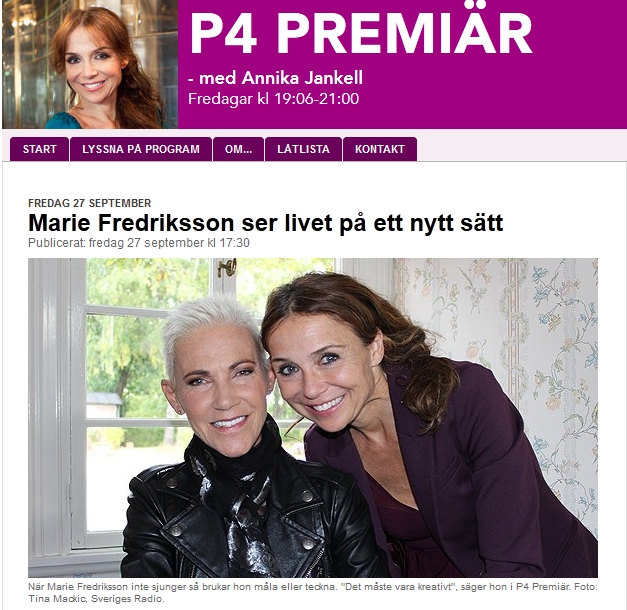
Swedish Radio programme P4 Premiär interviewed Marie during the presentation of her single in Stockholm last Tuesday.
Here is a transcript of the interview. We tried our best (Jud with a little help from Patrícia), just drop us a line if you would write things differently.
P4: How would you describe the artist Marie Fredriksson in year 2013?
Marie: Yeah… relatively fun artist. I have been working on this album for a loooong time…
P4: For how long?
M: well.. about 6 years. But I’ve been busy with Roxette for more than 2 years. I am so happy that the album is finally ready and with the single “Kom vila hos mig”, written by my husband.
P4: It’s a very nice song, but also a bit sad or a bit melancolic. Can you tell us what is it about for those who haven’t heard it yet?
M: What one feels inside.
P4: What is it about for you?
M: For me it’s about strength. It has given me a lot of strenght. When you think what I have gone through, I am very very happy about this song, it means a lot to me.
P4: After all you’ve gone through and now that you are healthy again, do you think it’s shocking to talk about cancer?
M: Yes, very much. It’s sad to talk about it again and again. I am now fine and healthy again for a looong time so let’s talk about other stuff.
P4: But what came out of this? what has changed?
M: Mainly, I got a stronger voice. I had a great voice before, but now it’s heavier. I am happy about that.
P4: Why do you think your voice changed?
M: Well, I don’t know. Probably age and of course what I’ve gone through. But why talk about that, it’s so long ago. I feel very well now.
P4: I gotta say that you are shining. One reads that people who have gone through such hard times are stronger. Do you think people realise what life is about after such experiences?
M: Yes, I think so.
P4: And your album is called “Nu!”. Are you good at living the present?
M: Oh yes, I am damn good at that haha! I love to live in the present, it feels very strong to live the present, it feels very powerful, it’s the best there is.
P4: Do you remember when you started back in the 80ies, how was Marie back then?
M: The first song that was a success was “Ännu doftar kärlek”. I wrote it together with Lasse Lindbom. We were so lucky and we had so much fun. It was great to get that much success with the song.
P4: Was it your dream since you were a kid to sing on stage, become a singer?
M: Yes! I used to wake up the whole family in the morning singing kind of arias, aaaahhh aaaaaah. I woke up all my family with that, everybody was like “cmon, shut up now”. But I went on, singing a bit lower. I was crazy to sing.
P4: And when did you find out that you had such a strong voice?
M: I guess when I sang at choirs and with my sibilings. I used to sing so strong. We were 5 of us, my brother was the oldest and then 4 girls. But too bad one of my sisters died in a car accident, I was 4 years old, that was horrible. But one doesn’t really realise when one is so small.
P4: So now that you will release a new album and you will go on tour next year, how does it feel, how do you plan it?
M: Yes! it will be sooo much fun! I really look forward to it and to start rehearsing.
P4: You have never been a primadonna and there was never a huge circus around you, you are very down to earth…is that right?
M: Ah.. I don’t know, it’s just the way I am. I can’t be any other way. Of course, we were very big when we did all those world tours with Roxette and we got the 4 number 1 in the USA, it was great.
P4: You’ve been famous since the 80ies with “Ännu doftar kärlek”. Was it hard when you were sick? People wanting to know how you feel, etc?
M: No… , well, of course it was hard, but now I am fine, so I am very thankful for every day. I see life in a totally new way nowadays.
P4: And how is it going with painting?
M: Oh! I haven’t had much time lately! I love it, I already did 3 exhibitions, but I like to do different things. I have to be creative with music, art…
P4: What do you do when you are not creative? Is there anything you do that is not creative?
M: Well.. I write texts sometimes, always did so. But I have to have something to do. Even though I also think it’s important to take it easy, maybe look at birds outside or something, do something outside the house, but it has to be warm, not too cold, haha!
P4: If you had to choose the absolute Marie Fredriksson song of all timesy, which one would it be?
M: Sparvöga, it means so much for me. Lasse and I wrote a lot of songs together, but this one I wrote myself. I got this offer to write this song for this TV series called “Sparvöga”, it was inspiring. And I got a lot of self-confidence because it was a success. And then comes “Tro”.
P4: What is your driving force?
M: My family, they mean everything to me. Without them I probably wouldn’t sit here today.
 udith: To start with, could you tell us about you, how you started to write about music and what you’ve done so far?